Physics is the field of science concerned with the study of observable and detectable phenomena in the universe. The way physicists explore the observable and detectable phenomena is termed the scientific method. That means that physicists do experiments to understand the origin and mutual relations between all the phenomena.
Figure 1 shows a pair of scales to determine the relation of a shared property between the objects in both scales. We have to slide the bar with the ruler to get horizontal equilibrium and the result is a relation between both objects that can be determined with the help of the length of a and the length of b.
This is not an easy and accurate method if we have multiple different objects. But if we slide the bar exactly in the middle and weight each object separately with the help of standardised objects (e.g. grams) we can express the weight of each object with the help of these standardised measurement units in the empty scale.
In other words, the International System of units (SI) is a method to simplify and standardise the measurement of relations. But what we have measured with the help of these units is still a relation between both objects. That is why the use of measurement units doesn’t transform the shared property of both objects into absolute properties. Because it is impossible to measure absolute properties. Actually, we humans are also a local composition of mutual relations, like all the other phenomena in the universe. That is why our senses – measurement instruments – can only measure relations.
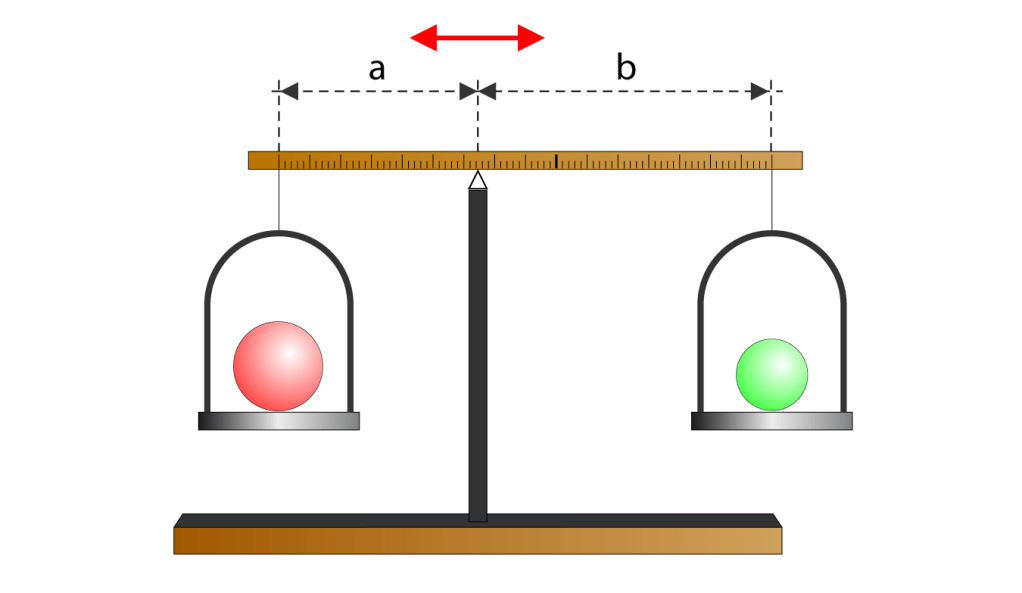
figure 1
If we think about the consequence that observable and detectable reality shows to be a relational reality, the question arises what kind of reality creates relational reality. Not at least because for most people it is a confusing idea that every “tangible” phenomenon inside the volume of our universe represents a relation. Moreover, mutual relations can only exist if there are differences. A difference in mass, a difference in motion, a difference in position, a difference in time, etc., etc.
Without local differences the properties of every “point” within the volume of our universe are the same. That means there is no motion, there are no boundaries, etc. However, this is not real. There are differences everywhere in the universe.
In physics every change of an observable and/or detectable relation is a change of the property “energy”. It was Albert Einstein’s famous formula E = m c2 that showed that matter (m) is just a local concentration of free energy (E). Moreover, Einstein concluded that the velocity of free energy – like visible light – is not instantaneous, the velocity shows to be a universal constant, the speed of light (c).
Although every change is the change of a relation, Max Planck discovered that the change of free energy – transferred by the propagation of an electromagnetic wave in vacuum space – is quantised. The quantisation of energy is expressed in Planck’s postulate E = h f. In other words, the quantum of energy (h) is a universal constant and f is the frequency of the electromagnetic wave (e.g visible light or gamma rays).
The quantum of energy (h) is a universal constant and its velocity in vacuum space is a universal constant too, the speed of light (c). But it is not for sure that the quantum of energy is a “solid” property because the existence of the quantum of energy only shows that the amount of change in relational reality is quantised. This in contrast with our experience that the universe shows itself as a sequence of fluent changes and the whole sequence is termed “evolution”. This concept of our universe as a continuum was expressed by Isaac Newton in his axioms about absolute space and time.
But there is a conceptual problem. Because the linear propagation of these quantised changes of free energy (E) has a constant velocity, the speed of light (c). So it is really difficult to argue that this universal velocity of the propagation of the quantum of energy in vacuum space is just a “variable” relation.
All the energy changes in the universe are conserved (law of conservation of energy). That means that the total amount of energy in the universe is a constant. We cannot create or destroy energy thus the total amount of the quanta of energy is a universal constant. Moreover, to keep the total amount of energy conserved, our universe has to be non-local.
Every quantum of energy (h) has momentum too. The Broglie relation shows that we can relate the wave length (λ) of the Planck-Einstein formula E = h f = h c / λ to momentum (p). Because the Broglie relation is λ = h / p. And last but not least, all the changes of linear momentum in the universe are conserved too (law of conservation of momentum).
Figure 2 shows Newton’s cradle. If I drop the ball at the left, the last ball at the right swings off at the moment the first ball hits the 5 adjacent balls. Newton’s cradle shows the manifestation of momentum at the macroscopic scale size. If we differentiate the radii of the metal spheres, we change the energy of each sphere and therefore the magnitude of its corresponding vector (arrows).

figure 2
In other words, linear momentum is theoretically not a singular fundamental property because it represents an amount of energy and the direction of the amount of energy (the vector). Momentum is a manifestation of the universal electric field (energy) and its corresponding magnetic field (vector field). Both fields together are termed “electromagnetic field”.
Quantum fields are part of relational reality too. Actually the universal electric field and its corresponding magnetic field are basic quantum fields. The Higgs field – the universal scalar field – is also a basic quantum field.
The relational properties of the basic quantum fields are described in quantum field theory. These properties are the manifestation of the local differences of these fields. Differences within the structure of each quantum field and also the interference between two or more basic quantum fields. The addition “basic” means that these fields represent relational reality at the smallest scale size. That is why the basic quantum fields are universal fields. These quantum fields exist everywhere in the universe. So we can state that the basic quantum fields together tessellate the whole volume of the universe.
Conclusion
If we think about it, it is hard to imagine that universal conservation laws (energy and momentum) and universal constants (the quantum of energy and the speed of light) are indispensable “ingredients” of a relational universe. So it is reasonable to expect that reality envelopes more than the mutual relations.

