In 1973 I started research in the field of the mathematical nature of reality. But somehow I was not impressed by the (limited) ideas about reality at that time. So when I stumbled upon Emanuel Swedenborg’s books about the non-observable reality experienced by the human consciousness I read them all, except De Telluribus in Mundo nostro Solari (not available at that time). I was really impressed by the scientific clarity of the observations of Emanuel Swedenborg, although there was no direct relation between the mathematical nature of reality and Swedenborg’s observations.
Of course there are modern publications about non-observable reality too. Like the article of Pim van Lommel et al. in The lancet, volume 358, Issue 9298, P2039-2045, December 15, 2001 (Near-death experience in survivors of cardiac arrest: a prospective study in the Netherlands).
There are even military sightings of unidentified areal phenomena (UAP’s) that show the characteristics of non-matter “objects”. That means that the velocity and movements of these “crafts” don’t show the limitations of normal rest mass (matter). There are even videos made in outer space that show that these “space UAPs” are only visible at infra red frequencies.
However, there exists another meaning of non-observable reality. It is a reality that cannot be described in terms of phenomenological properties. Because a phenomenon represent a mutual relation between local differences inside the volume of our universe. So if we want to describe this non-observable (underlying) reality of the universe we have to construct concepts with the help of reasoning. Like the concept of an underlying reality that is responsible for the existence of phenomenological reality. A concept that was already described by the ancient Greek philosopher and mathematician Parmenides of Elea.
In modern physics we try to understand reality with the help of experiments. Theorists are convinced that research with the help of the scientific method will result in a deep insight in the structure and dynamics of the universe and the result will be a theory of everything). But the measured properties of a phenomenon are the result of the local conditions around the phenomenon. So there is quite a lot to measure and to interpret.
An exception are properties that exist everywhere in the universe. That means that these properties are part of the properties of every phenomenon in the universe. Like the universal constants (the quantum of energy; the speed of light), the universal conservation laws (energy and momentum) and the universal principles (uncertainty principle and the principle of non-locality). In other words, it makes more sense to create a model with the help of the universal properties. Too much theories and corresponding data is not really helpful.
If relational reality is about the observable and detectable phenomena, the question arises what it is that underlies relational reality. Maybe the question is a bit awkward because it is for sure that the underlying reality and relational reality are actually “the same thing”. It is comparable with an iceberg that is drifting in the sea. About 10% of its volume is visible above the waves and the remaining 90% is hidden under water.
However, the universe is an enormous volume without walls.[1]That means that the separation between both parts of reality exists “at every point” within the volume of the universe. Because it is the separation between the variable part of the structure of the volume of the universe and the invariant part of the structure. That is obvious because the volume of the universe shows to be 3D Euclidean space.
The concept is comparable with the thoughts about the nature of reality of the ancient Greek philosopher and mathematician[2] Parmenides of Elea and his student/philosopher Zeno of Elea. Unfortunately Parmenides’ original paper about nature was lost and also Zeno’s book of 40 paradoxes that explained that the paradoxes don’t exist if we use Parmenides’ concept about reality. What we know are the quotes and comments of other ancient Greek philosophers about Parmenides’ poem “On Nature” and about Zeno’s paradoxes.
My research is on the mathematical (geometrical) structure of the universe (quantised space). Because I am familiar with philosophy I knew Parmenides as the “father” of the Western ontology. But a decade ago I discovered that Parmenides’ concept of reality is actually about discrete (quantised) space. A conceptual framework that envelopes relational reality and the underlying reality that creates relational reality.
Parmenides had another student, named Melissus of Samos. His work with the title “On Nature” describes his own replication/interpretation of the ideas and arguments of Parmenides. Unfortunately, his work is also lost so what we know is described by other/later philosophers. The Wikipedia page of Melissus of Samos gives information about Parmenides’ ideas. Although the Wikipedia page also shows that not everyone is familiar with the concept of a creating rest frame. That is why they draw the wrong conclusion that some of Melissus’ arguments are logically flawed.
Figure 1 shows in a schematic way Parmenides’ concept. The universe as one being that doesn’t move although it has a structure with a metric (in line with Zeno’s paradox of Achilles and the tortoise). There must be a metric (≈ ℓc) because without the existence of indivisible dynamical units (“atoms” in ancient Greek) there are no distinguishable differences to be find in the universe. Infinity small units create a universal uniformity.
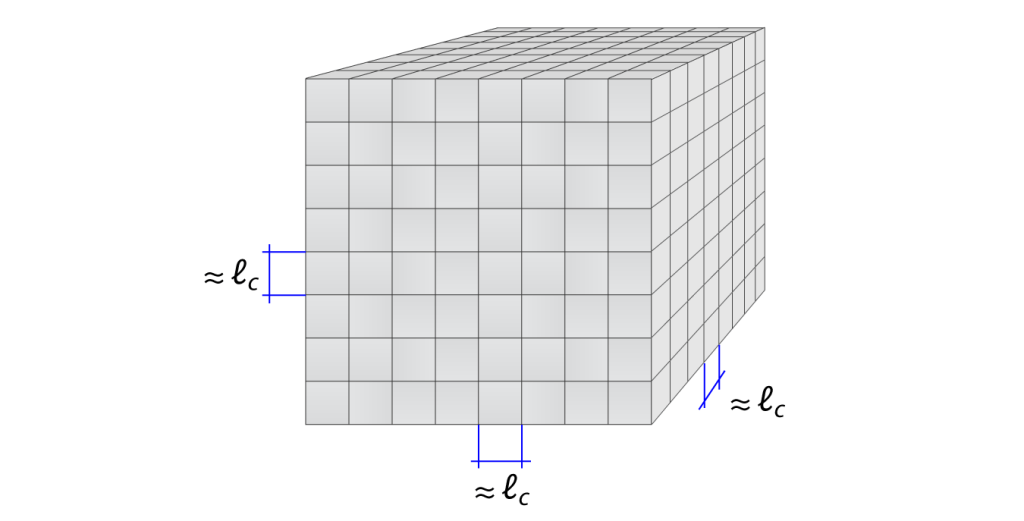
figure 1
Parmenides’ concept of one being means that the volume of the units of the underlying structure of the universe is invariant. This in line with the experiments because the volume of a phenomenon doesn’t increase or decrease its energy and visa versa.
There is a short YouTube video of Roger Penrose mentioning the 2 most important equations in physics (E = m c2 and E = h f). However there are 2 even more important equations he didn’t mention in the video. The first one is about the conservation of energy (ΔE = 0) and the second one about the conservation of vectors (Δv = 0).
Both equations represent the phenomenological part of our universe, the universal electric field (energy) and its corresponding magnetic field (vectors). In other words every change of energy generates corresponding vectors. The smallest change of local energy is the Planck constant, the quantum of energy (h). The linear propagation of the quantum of energy is known as the constant speed of light (≈ 300.000.000 m.s-1).
The small cubes in figure 1 symbolise in a schematic way the units of Parmenides’ underlying creating structure and the large cube symbolise the whole universe. No matter if the size of the real universe is finite or infinite. So how do these very important basic equations and constants in physics relate to Parmenides’ concept of an underlying reality that creates phenomenological (relational) reality?
The schematic concept (figure 1) isn’t complete. Because there is no mechanism that is responsible for all the changes in the universe. And more worse, there exist a vacuum in outer space while figure 1 shows some kind of a “tangible” structure that pervades the whole universe. However that is 100% in line with the concept of Parmenides. He stated that there exists no “nothing” in the universe. All the phenomena and all the empty space are created by the same underlying reality that “fills” the whole universe.
Conclusion
Reality like we observe and detect is relational reality. Therefore it is reasonable to assume that physics is about the relations between the units of the structure of the universe (figure 1). The consequence is that the units in figure 1 must represent basic geometrical properties and also an internal mechanism that is responsible for all the continuous changes in the universe.
References:
- S.E. Grimm (2024); “The box without walls”
https://zenodo.org/record/14540104 - T. Freeth, D. Higgon, A. Dacanalis, et al. “A Model of the Cosmos in the ancient Greek Antikythera Mechanism”.
Nature, Scientific Reports 11, 5821 (2021).
https://doi.org/10.1038/s41598-021-84310-w

