The idea that reality is deterministic is not really popular. We like to think that we have free will because it suggests that our personal achievements are deserved. YouTube is full of videos that tell the listeners that if they want they can change their live to become healthier and happier too. Remote viewers and channellers describe a multidimensional universe of experiences that can be navigated with the help of our free will.[1] However, experiences are not always the best advisers to understand reality.
There are 2 universal conservation laws. Both universal laws describe the continuous changes within the volume of our universe. So it is about the dynamics – relational reality – and the consequence is that the 2 laws describe the conservation of all the changes within and between the universal electric field and its corresponding magnetic field.
The universal electric field is a topological field, responsible for e.g. wave phenomena, probability[2] and the quantum of energy (QM). The magnetic field is a vector field, generated by the changes of the universal electric field and mediated by all the identical scalars of the Higgs field (in vacuum space all the scalars have the same magnitude).
The total amount of changes at exactly the same moment of the universal electric field is conserved, in line with the principle of non-locality. But we cannot conclude that it proves that our universe is deterministic because determinism is not only about the sum of all the changes, it is about the relations between all the changes too. However, all the changes of the universal electric field are quantised – the Planck constant (h) – and the propagation of the changes within the structure of quantised space is a constant too, the speed of light (c). The vectors of the magnetic field are generated by the changes of the universal electric field[3] so there is no “escape”: our universe is 100% deterministic. No matter all the experiences that suggest that we have a free will.
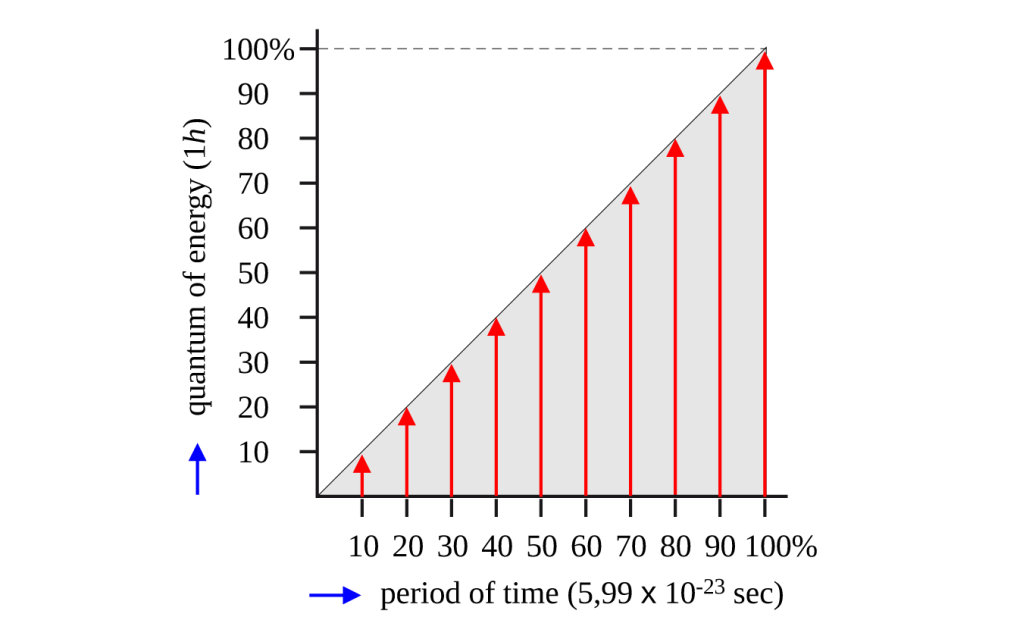
figure 1
The previous post described the asymmetry between the changes within the universal electric field and the generated corresponding vectors of the magnetic field under influence of matter. So how do we have to interpret the asymmetry and how does it affect relational reality?
Energy is the creation of the internal scalar mechanism of every unit of quantised space. Because the unit of quantised space is a deformed scalar. It manifests itself by the fluent changes of the surface area of the units. In other words, the quantum of energy is surface area. Like the formula about the equivalence of matter (m) and free energy (E) shows: E = m c2.
Figure 1 shows the increase of surface area of 1 quantum of energy and the generated corresponding increase of the magnitude of the involved vectors. Of course there exist already local vectors thus the increase of topological deformation (1 h) add or subtract the magnitude of the vectors to or from the existing vectors. In between the period of 5,99 x 10⁻²³ second – the constant of quantum time (1 tq) – there is no change in the direction of the ongoing topological deformation of the unit. Because every unit has an invariant equal volume and all the volumes tessellate the volume of the universe. But the magnitudes of all the vectors in the universe change in a continuous fluent way because vectors act instantaneously (not limited to the speed of light).
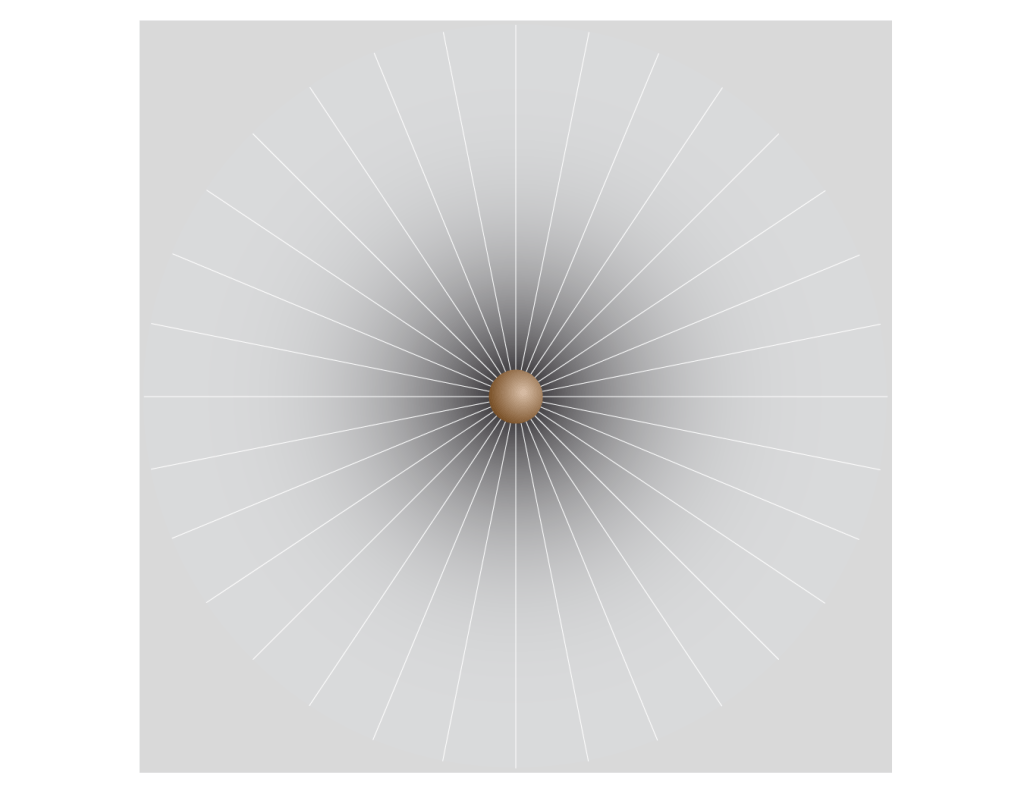
figure 2
If there is locally an asymmetry between the universal electric field and the corresponding vectors of the magnetic field we cannot hypothesize that the quantum of energy is locally geometrical variable. So we have to conclude that local vectors don’t reflect the topological deformation of the involved units always in a 100% corresponding way. Now what does this means?
Figure 2 shows a planet, the gravitational vectors (white lines) and the exponential topological deformation of the universal electric field caused by the gravitational vectors. It is vacuum space so the topological deformation corresponds with the gravitational vectors. In other words, we can describe the force of gravity at the macroscopic scale size with the help of the magnitudes of the gravitational vectors (Newton) or by the topological deformation of the universal electric field (Einstein). However, the origin of gravity is the decrease of the magnitude (radius) of one or more scalars of the Higgs field. That is why Newtonian gravity is a more accurate model than Einstein’s “curved spacetime”. Because Einstein didn’t described the volume of the universe, he described the macroscopic topology of the universal electric field around matter. Figure 3 shows in a schematic way the vector mechanism of Newtonian gravity in relation to figure 2 (Newtonian gravity as a push force from vacuum space around matter).
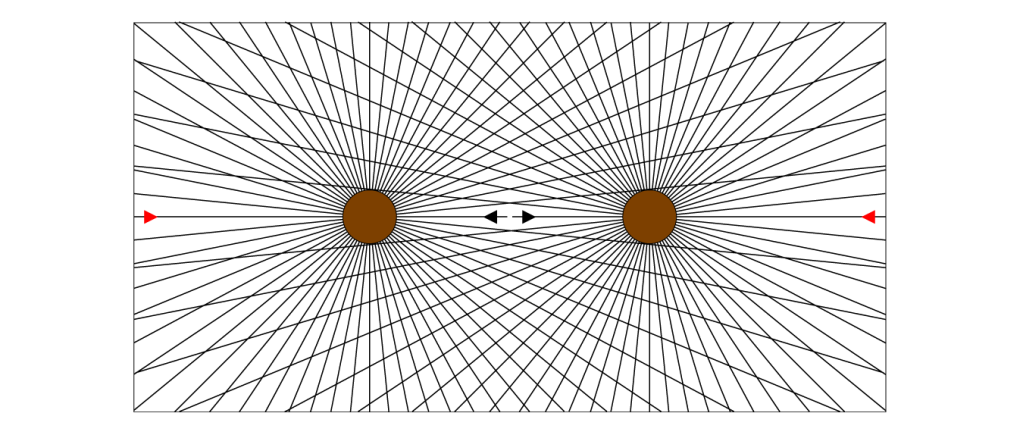
figure 3
The image of the gravitational vectors shows that there is a constant dynamical equilibrium between all matter in the microcosm and macrocosm because of the generated vectors that are “locked” to the mass. It clarifies why the principle of non-locality acts instantaneous instead of an influence that is limited to the speed of light. Although Newton’s cradle is a macroscopic object and the metal spheres are not 100% rigid it shows why the number of identical metal spheres don’t significantly affect the immediately reaction of the last sphere in the row (the mediation of vectors).
Figure 4 shows in a schematic way one unit of quantised space. Visible is the scalar (inscribed sphere), the schematic boundary of the unit, the vectors that correspond with the 12 points of contact with the adjacent scalars and the continuous topological deformation of the 12 faces of the unit (light blue arrows). A change of the shape of the unit (light blue arrows) results in a change of the scalar vectors (black arrows). The total amount of topological deformation during 1 tq is fixed because in order to change its shape a unit has to transfer volume inside its boundary under influence of the active vectors of the scalar. The consequence is that the local asymmetry between the universal electric field and the corresponding magnetic field changes the direction of the topological deformation of the unit if the asymmetry is not equal distributed. In other words, it is an alteration of the symmetry between both corresponding fields.
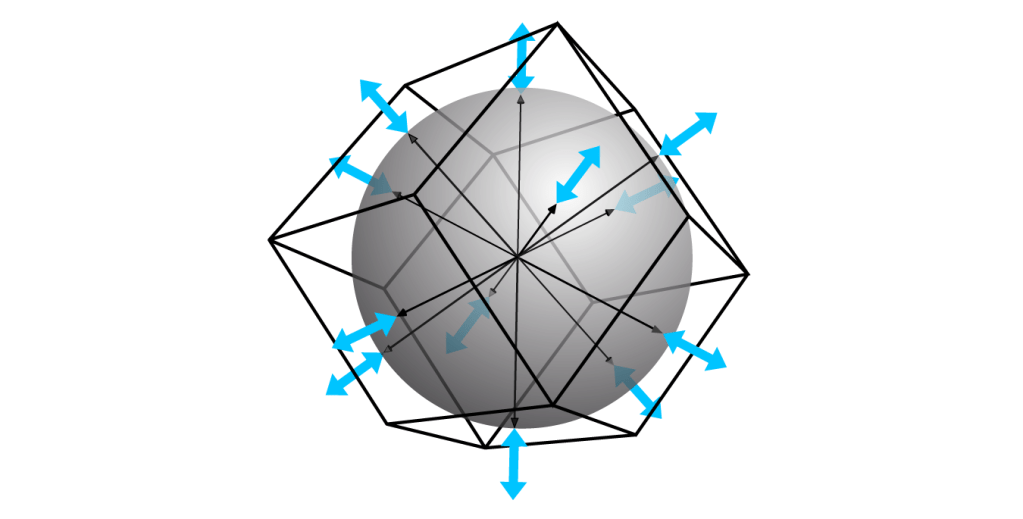
figure 4
If a local concentration of energy without decreased scalars is created by involved units of quantised space the units around the centre of the concentration of energy are forced to deform like the units are part of a resultant circular motion. A concentration of energy cannot propagate linearly with the speed of light within the structure of quantised space. Because there is only one linear velocity in relation to energy changes: the speed of light. Figure 5 shows the resultant motion and it is clear that matter – rest mass – shows a different behaviour because of the vectorisation of the scalars of the flat Higgs field in vacuum space around.

figure 5
The asymmetry between the universal electric field and its corresponding magnetic field is created by decreased scalars, actually “holes” in vector space (mediated vectors within the scalar lattice of the flat Higgs field). In other words, it is reasonable to suppose that rest mass and the asymmetry in some way are “entangled” at the smallest scale size.[4] However, black holes are macroscopic celestial bodies and the source of an enormous amount of asymmetry between the universal electric field and its corresponding magnetic field. In other words, the local asymmetry of a rest mass carrying particle is not comparable with the asymmetry of a black hole.
This forces us to think about asymmetry in a way that is comparable with “building blocks” of asymmetry. An asymmetry that will manifest itself as basic local surpluses of vector magnitudes in relation to more and more complex configurations of these basic surpluses. It is tempting to compare these vector configurations with Plato’s theory of forms.
Conclusion
The existence of a deterministic universe where all the dynamical changes are synchronised doesn’t violate human experiences that seem to be not deterministic and even creations of free will. Because in phenomenological reality vectors act as hidden variables.
References:
- Steven A. Swartz; website https://stephanaschwartz.com/
The website has links to his books and scientific papers.
YouTube: https://www.youtube.com/watch?v=wXPBiMvxiRU - (19-09-2021); “The mechanism behind probability”
https://zenodo.org/record/5515861 - (26-06-2020); “On the construction of the properties of discrete space“
https://zenodo.org/record/3909268 - (10-11-2024); “Consciousness in discrete space”
https://zenodo.org/record/14062564

