If there exists an underlying reality that is responsible for the emerging of relational reality, what will be the consequences? Because in our scientific culture theoretical physicists have only described relational (phenomenological) reality. Fragmented descriptions that are known as “grand theories”.
Descriptions like the Standard cosmological model (ΛCDM), Einstein’s theory of Relativity (curved spacetime), the Standard model of particle physics, Quantum mechanics and its successor Quantum field theory. But every theorist agrees that the grand theories are more or less approximations of physical reality. These approximations of relational reality facilitate accurate calculations and are at the basis of the development of scientific and technical applications.
So if we switch from the approximations of relational reality to more absolute description of reality – in line with Parmenides’ concept of reality – what are the consequences? Will our present conceptual framework of the grand theories still stands?
At the cosmological scale size our universe shows itself as a continuum. Not only in respect to its volume (space) but also in respect to the continuous change of all the relations (time). If we accelerate a clock we observe that its internal rate of change slows down. But an identical not accelerated clock during the same experiment doesn’t show this alteration of its rate of change. That means that the use of the term “time” for the rate of change of phenomena under different conditions is not really helpful. Because the consequence of the experiment is that every phenomenon has its own “time” in relation to its internal and external conditions. In spite of the fact that the smallest amount of change is fixed – the quantum of energy (h) – and the linear velocity of the quantum of energy in vacuum space is fixed too, the constant speed of light (c). In other words, “time” as the universal rate of change everywhere in the universe cannot be “relative”.
Figure 1 shows Parmenides’ concept in a schematic way. The reality that underlies the model is responsible for all the known mutual relations in the universe. But it is clear that the units of the structure cannot change their shape independently from all the other units. It shows that Einstein’s “time” cannot be fundamental, it is an effect. The rate of change of local compositions of energy.
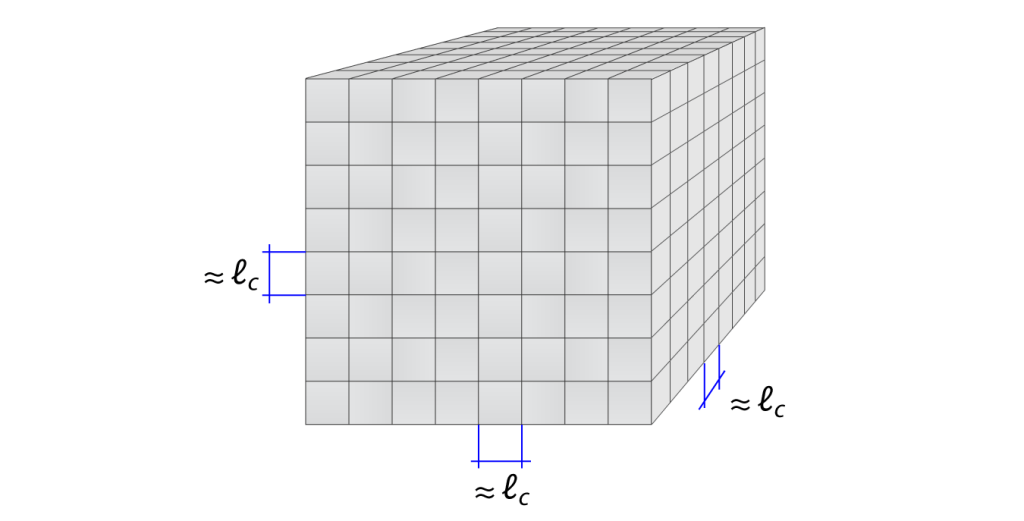
figure 1
The basic idea of the ΛCDM is the big-bang hypothesis. The hypothesis assumes that about 13,7 billions years ago all the energy of the universe was fitted inside a “singularity, a volume less than the size of a point”. The idea originates from the extrapolation of the Hubble law, the expansion of the volume of the universe because of the increasing non-Doppler red shift of light related to the increasing distance of galaxies. But in spite of this, the size of star systems and galaxies are not influenced by the expansion of space. It was the famous English astronomer Fred Hoyle who opposed the big-bang hypothesis and correctly argued that if space itself expands, everything in the universe will expand at the same rate. So nobody can determine the expansion. Nevertheless, according to the big-bang hypothesis in the ΛCDM the volume of space and the density of energy are supposed to be the same.
Figure 2 shows a Palladium lattice. The different colours are only meant to enhance the contrast. At atmospheric pressure and room temperature (e.g. 20 decrees Celsius) the Palladium lattice adsorbs Hydrogen atoms. Because the smaller Hydrogen atoms fit in the open space between the Palladium atoms. There is also another reason why these different types of atoms attract each other and this is because both types of atoms have the same electronegativity (Pauling scale 2.20).
If we lower the temperature of the Palladium lattice with a number of Hydrogen atoms inside – for example with the help of liquid Nitrogen – the Palladium lattice gets deformed and its surface area shows small cracks. The cause behind the cracks is simple. Lowering the temperature of the lattice decreases the amplitudes of the vibrations of all the involved atoms. Now the spaces in between the Palladium atoms become too small for the Hydrogen atoms to fit inside without damaging the lattice.
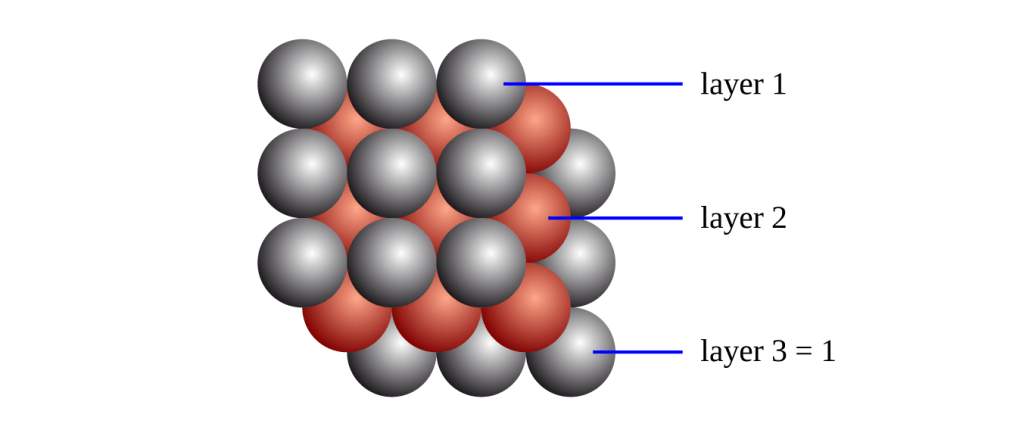
figure 2
The consequence is that the increase or decrease of the energy of a phenomenon – e.g. a particle – doesn’t change its volume. An energy supply or extraction changes only the velocity of its motion. This is ordinary text book stuff. In other words, energy and volume are not equal or directly related in relational physics like the big-bang hypothesis suggests.
One can argue that the big-bang hypothesis was the only “reasonable” idea to explain the non-Doppler red shift of the light of distant galaxies. But that is not true. There are other explanations but these hypotheses are not favourite because in quantum field theory particles are supposed to be local excitations of the basic field structure in the universe. Although Einstein’s famous formula E = m c2 shows that a local energy density of the mass (m) originates from the concentration of free energy (E) from vacuum space around the mass. That means that the continuous energy redistribution in our universe has to be described in terms of set theory. In line with the existence of the law of conservation of energy.
The general concept of quantum field theory is that the observable and detectable phenomena emerge from the properties of the basic quantum fields.[1] The consequence is that the supposed energy singularity at the start of our universe (big-bang) enveloped the basic quantum fields too. These basic quantum fields are the universal scalar field (Higgs field), the universal topological field (electric field) and its corresponding vector field (magnetic field). However, the gravitational field is not a basic quantum field. No matter if the field is described with the help of the theory of general relativity or with the help of Newtonian gravity. Because in 1920 Einstein stated that without matter in the universe there exist no curved spacetime.[2] In 2011 Eric Verlinde showed that Newtonian gravity is an emergent force field too.[3]
The structure of the basic quantum fields tessellate the volume of the universe. The consequence is that if space expands the general structure of the basic quantum fields expands too. The basic quantum fields generate all the observable and detectable phenomena thus even in QFT Fred Hoyle’s argument still stands.
At the other side of the scale size – the microcosm – the present grand theories are quantum mechanics and its succeeder quantum field theory, actually the Standard model of particle physics. Even physicists agree that the “tangible” reality that underlies quantum mechanics is unknown[4]. Anyway, the description of relational reality at the smallest scale size – the Standard model – lacks a trustworthy framework. Because the Standard model uses the Planck units to create a description of relational reality that is smaller than the scale size of the observed asymptotic freedom.
Max Planck derived the Planck units with the help of the Planck constant (h), the speed of light (c) and the gravitational constant (G). But gravity is an emergent force field thus the Planck units don’t exist. Not at least because he couldn’t explain his use of the gravitational constant in relation to the unification of all the fundamental forces. The consequence is that the quark/gluon hypothesis doesn’t describe physical reality in an accurate way. No matter that the used conceptual framework to construct the Standard model originate from quantum field theory.
Conclusion
If we switch from the approximations of relational reality – the grand theories – to a more absolute description of reality it is unavoidable that all the grand theories will be replaced by one conceptual framework.
References:
- Art Hobson (2013); “There are no particles, there are only fields“.
American journal of physics 81, 211. DOI: 10.1119/1.4789885.
https://arxiv.org/ftp/arxiv/papers/1204/1204.4616.pdf - A. Einstein (1920); “Ether and the Theory of Relativity”
Methuen & Co. Ltd, London, 1922.
|https://mathshistory.st-andrews.ac.uk/Extras/Einstein_ether - E. Verlinde (2011). “On the origin of gravity and the laws of Newton”.
Journal of High Energy Physics 4, april 2011.
DOI: 10.1007/jhep04(2011)029
https://arxiv.org/abs/1001.0785 - Sean Carroll (2019); “Even physicists don’t understand Quantum Mechanics” (Worse, they don’t seem to want to understand it) New York Times, 07-09-2019. https://www.nytimes.com/2019/09/07/opinion/sunday/quantum-physics.html

