Recently I saw an interview about a new hypothesis that the supposed particles that mediate the gravitational force – gravitons – have mass too. So the hypothesis was nicknamed “heavy gravity”. There were some speculations in the comments about the relation between Dark matter and consciousness too. Inclusive a relation between these “heavy gravitons” and Dark energy. So maybe it is relevant to describe these phenomena with the help of quantised space (so the next post is about Dark energy).
In cosmology the dominant force between all the large celestial structures is gravity. That is really problematic because gravity is an emergent force. Because without matter there exist no gravity; not in Einstein’s theory of General relativity[1] and not in Newtonian gravity.[2] In quantum field theory all the phenomena – inclusive matter – are created by the basic quantum fields.[3] So if cosmologists speculate about the start of the observable universe (ΛCDM) its existence is a creation by the basic quantum fields that existed already everywhere in the universe. These basic quantum fields interact with each other and within their individual structure, like the continuous redistribution of energy everywhere in the universe within the structure of the universal electric field. The concept of quantised space – described by Parmenides of Elea some 2500 years ago – unifies these basic quantum fields into one spatial structure that is the volume of the universe.
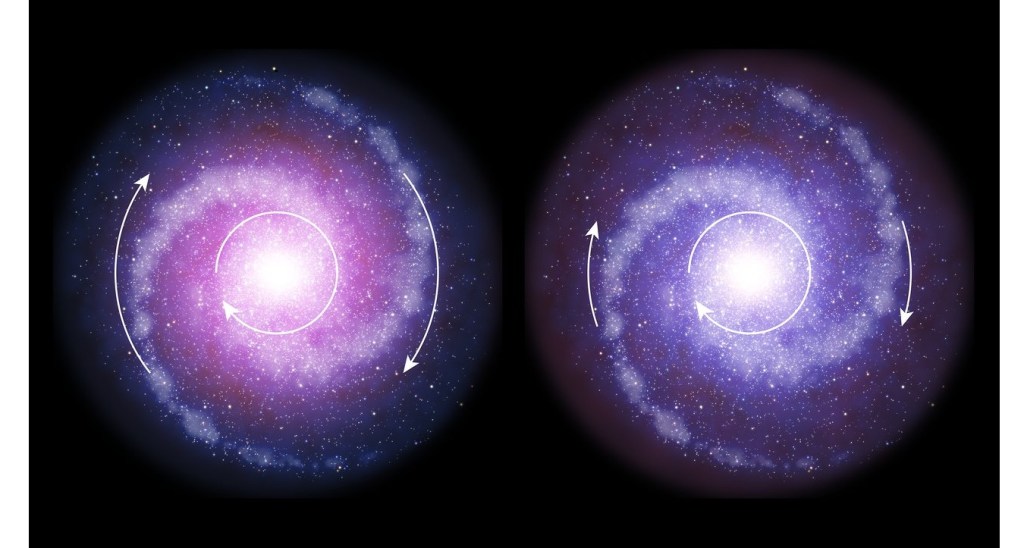
Schematic representation of rotating disc galaxies in the early Universe (right) and the present day (left). Observations with ESO’s Very Large Telescope suggest that such massive star-forming disc galaxies in the early Universe were less influenced by dark matter (shown in red), as it was less concentrated. As a result the outer parts of distant galaxies rotate more slowly than comparable regions of galaxies in the local Universe.
Dark matter is what astronomers have termed Dark matter. It originate from the observation that the velocities of the nearby stars around the sun are not in line with their amount of mass (Jan Hendrik Oort). Soon it was observed too that the rotational velocity of spiral galaxies doesn’t correspond with the mass of the stars further away from the centre of the galaxy either (figure 1). The image shows a galaxy with Dark matter (left) and one without at the right. The same rotational velocity in the centre of both galaxies but a higher rotational velocity at the outskirts of a galaxies with Dark matter.
There are papers that suggest alternative theories of gravitation (like MOND) but astronomers have argued that the observations of colliding clusters of galaxies – like the Bullet cluster (figure 2) – are not in line with these alterative theories of gravitation.
The blue colour in the image of the Bullet cluster shows Dark matter. That seems crazy because we cannot observe Dark Matter. The blue colour represents calculated Dark matter. Because the light of galaxies further away – behind the region of the Bullet cluster – shows a weak form of gravitational lensing. That means that the light of these further away galaxies is dispersed a bit because of an invisible amount of mass (Dark matter) in between these galaxies and the observer. Actually the bullet cluster.
Of course there are other observations that are in line with the supposed existence of Dark matter but the deviant rotational velocity of spiral galaxies and the observation of colliding galaxy clusters are significant examples.

figure 2
Gravitational lensing was predicted by Albert Einstein because of his hypothesis that matter curves the geometry of space itself. However, it is not possible that the volume of space can curve if about 74% of the volume of the universe is “occupied” by the scalars of the Higgs field. The scalars together form a rigid lattice of spheres (the flat Higgs field) because the sphere is the only 3D geometrical object that is a true scalar. The consequence is that Einstein’s curved space envelopes only about 26% of the whole volume of the universe.
Unfortunately this 26% of the volume of the universe is not spacetime but it represents the volume of the structure of the universal electric field. So it is easy to conclude that Einstein’s theory of General relativity is not a better description of the “tangible” properties of Newton’s absolute space. In other words, Einstein’s theory of General relativity is about the influence of matter on the topology of the structure of the universal electric field. That is obvious because matter is concentrated energy and energy is the variable property of the topology of the universal electric field.
Now we face the problem that cosmologists and physicists have the opinion that the properties of large structures in the universe are determined by Einstein’s theory of General relativity. That implies that matter curves space(time). So there is the hypothesis that Dark matter is the result of an enormous amount of weak interacting massive particles (WIMPs) in the universe. But massive particles are rest mass carrying particles so every WIMP must “envelope” decreased scalars of the Higgs field too. Experiments to detect the existence of WIMPs are not successful, because Dark matter is only detectable in an indirect way by astronomical observations.
If Einstein’s theory of General relativity describes the deformation of the universal electric field under influence of Newtonian gravitational vectors the question arises why we cannot detect Dark matter in our solar system. Because Dark matter is not a fantasy of astronomers. The Bullet cluster shows the evidence of its existence as a “tangible” energy phenomenon.
Dark matter
If mass is a concentration of energy within the structure of the universal electric field (E = m c2) it is evidently that there must be some kind of a “power” to concentrate free energy (E) within the structure. The mechanism is described in previous posts and I have termed it the scalar mechanism. Because in geometry every unit of quantised space can be interpreted as a decreased scalar under influence of all the other units that tessellate the volume of the universe. This type of concentrated free energy doesn’t emit electromagnetic waves like matter. Because concentrated free energy represents just a local energy density. It isn’t stable like a rest mass carrying particle so the energy density is comparable with local amplitudes. And amplitudes are everywhere in vacuum space.[4]
If the scalar mechanism of a large number of units of quantised space have concentrated so much energy that one of more scalars of the local flat Higgs field decrease their magnitude, the concentration of energy can increase further and the result is the concentrated energy of a rest mass carrying particle. But it is obvious that the scalar mechanism of every unit of quantised space doesn’t stop trying to minimise the surface area of the unit.
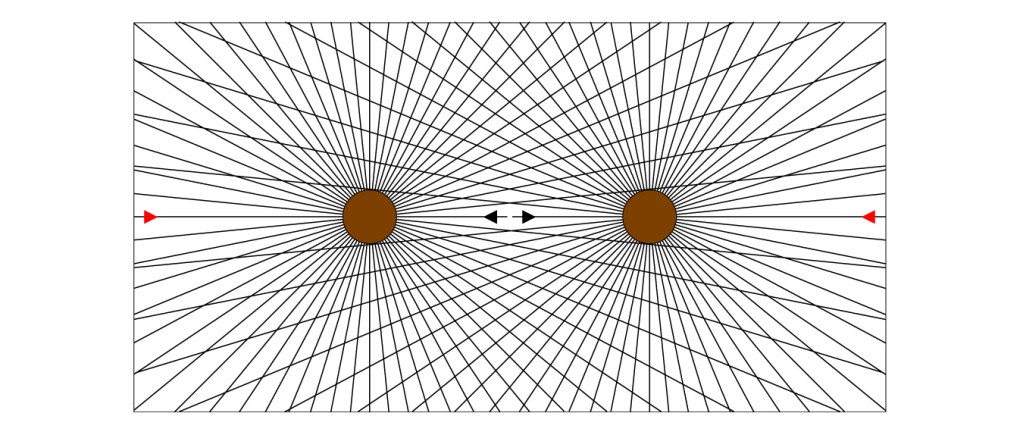
figure 3
However, the continuous energy transformations in the universe are not unlimited. The total amount of energy is conserved and the total amount of corresponding vectors too. That means that the linear propagation of 1 quantum of energy is equal to the speed of light and the linear propagation of the corresponding vectors is instantaneous. The consequence is that vectors will stabilise local energy densities between large distances long before these energy densities can interfere with each other by exchanging energy. In other words, the non-locality of gravitational vectors facilitate the direction of the propagation of the local energy concentrations – like celestial bodies – in vacuum space.
Because the scalar mechanism of every unit don’t stop to minimise the surface area of every unit the deformable part of every units continue to concentrate energy (topological deformation). So there exists some kind of an average increase of created matter in the universe. More or less in line with the general idea of the lambda cold dark matter model.
However, concentrations of energy that cannot transform into rest mass can be compared with fog. There is a higher amount of average energy density (topological deformation) but it will not transform into matter in the short term. So there is no difference between real matter and Dark matter because the underlying mechanism for both phenomena is energy concentration. The consequence is that we find this “fog” of higher concentrated free energy around matter. Especially around celestial structures like star systems, galaxies and clusters of galaxies.
The force of gravity
The concentration of matter is the result of gravitational vectors from vacuum space around. Actually the vectorisation of the flat Higgs field in vacuum space because of the decreased scalars in the centre of matter. But the concentration of free energy by the universal electric field is still active because of the scalar mechanism of every unit of quantised space.
The gravitational constant is measured in our solar system. The sum emits a continuous amount of energy (electromagnetic radiation and particles) thus there are no regions of increased energy density (Dark matter) in our solar system to be find. Simply because there is too much disturbance of the universal electric field in vacuum space around the sun. That means that the measured gravitational constant (G) represents only the influence of the vectors of Newtonian gravity.
In between the star systems there is Dark matter and of course also in the outer regions of a galaxy.
Figure 4 shows in the centre a spiral galaxy. The black arrows symbolise the concentration of free energy during the evolution of the galaxy and the blue arrows the gravitational vectors because of the created matter. In other words, the creation of a galaxy “out of vacuum space” needs a much, much larger volume of involved units than the volume of the galaxy itself.
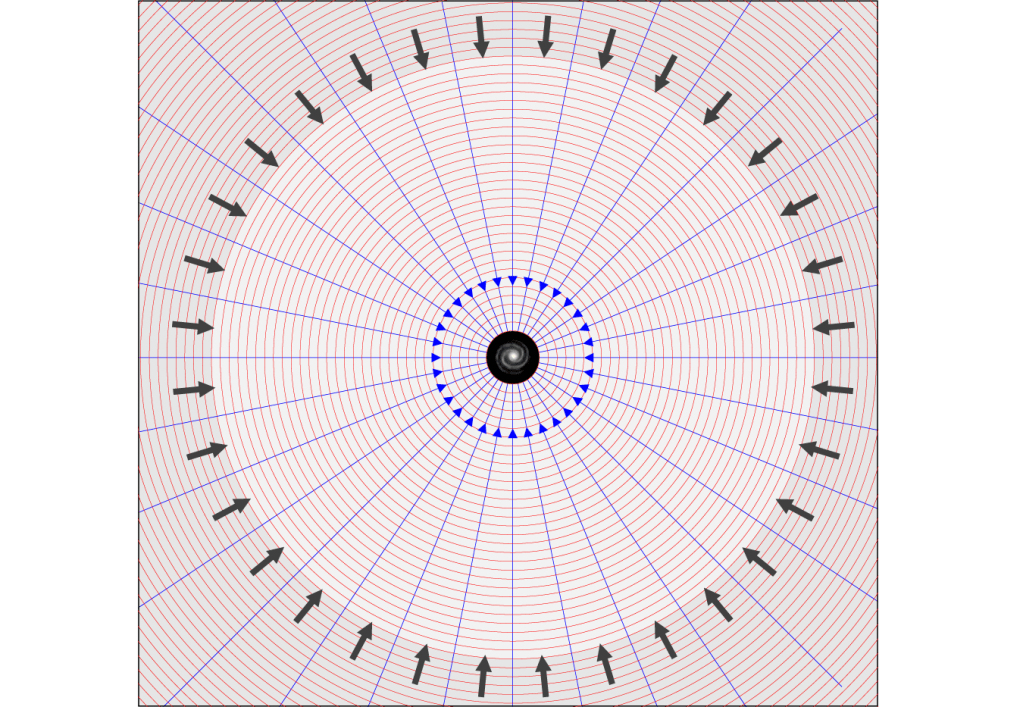
figure 4
The velocity of a rest mass carrying particle is determined by the amount of topological deformation of the particle itself in relation to the average deformation of vacuum space around. That means that if we increase the average amount of deformation (energy) in vacuum space around, the propagation of the particle from position I to position II needs less time (n x 1 tq). The consequence is that the existence of Dark matter in between star systems and at the outskirts of galaxies speeds up the rotational velocity of the star systems further away from the centre of a galaxy. Not because Dark matter is massive (like WIMPs) but because it represents an increase of the average energy density of vacuum space (see figure 1).
Conclusion
Dark matter is what Einstein called “mass”. A less dense concentration of free energy in relation to rest mass (matter). Nevertheless, because of its large volume, the mass of Dark matter has linear momentum too. That is why figure 2 shows that Dark matter (blue) continuous its motion in front of the colliding matter of the galaxies of both clusters (pink colour). And last, it is difficult to imagine a direct relation between Dark matter and general consciousness.
References:
- A. Einstein (1920); “Ether and the Theory of Relativity”
Methuen & Co. Ltd, London, 1922.
|https://mathshistory.st-andrews.ac.uk/Extras/Einstein_ether - E. Verlinde (2011). “On the origin of gravity and the laws of Newton”.
Journal of High Energy Physics 4, april 2011.
DOI: 10.1007/jhep04(2011)029
https://arxiv.org/abs/1001.0785 - Art Hobson (2013); “There are no particles, there are only fields“.
American journal of physics 81, 211. DOI: 10.1119/1.4789885.
https://arxiv.org/ftp/arxiv/papers/1204/1204.4616.pdf - C. Riek et al. (2017); “Sub-cycle quantum electrodynamics”.
Nature 541, 376-379 (2017).
https://doi.org/10.1038/nature21024

