The previous post was about gravity and its relation with the existence of Dark matter. There were some speculations that Dark matter and Dark energy are related. This post clarifies the underlying relation.
The idea that the observable universe expands, originates from the observation that the light of distant galaxies is red shifted. The further away the galaxy, the more the light of the distant galaxy is red shifted (Hubble’s law). Astronomers first assumed that the red shift was caused by the motion of the galaxies away from the observer. In physics this type of red shift of electromagnetic waves is called the Doppler effect. In 1845 the effect in relation to sound waves was examined by the Dutch meteorologist Buys Ballot with the help of a passing train and the sound at a continuous frequency by a trumpet. There is a painting of the experiment on a wall of a house next to the railway where the experiment was done. On my way to the dentist in Utrecht, the Netherlands, I see the wall painting. It is on StreetView too ;-)
However, better telescopes showed that the amount of red shift became so dominant in relation to the frequency of the light of nearby galaxies that the most distant galaxies had to move with a velocity higher than the speed of light. So it was clear that the cosmological redshift was not caused by the velocity of the motion of the galaxies (Doppler effect). If space can curve under influence of matter – Einstein’s theory of General relativity – it is not so far-fetched to assume that space can also expand “around matter”. Because the expansion of vacuum space clarifies the lengthen of the wave length of the emitted electromatic waves by far away galaxies. The direct relation between the non-Doppler red shift and the expansion of space can be calculated because of the existence of standard-candles (cosmic distant ladder).
Unfortunately better measurements showed that the non-Doppler red shift is not 100% linear. There is observational evidence that the red shift increases during the evolution of the universe. That means that our present universe expands faster in comparison with the expansion of the universe during a same period of time in the past. That is impossible without some kind of energy and that is why the cause behind the accelerated expansion is termed “Dark energy”. Because we don’t know the origin of this enormous amount of energy.
Note that the entire theoretical framework is build upon the assumption that Einstein’s theory of General relativity is correct and quantum field theory is not applicable at the macroscopic scale size. And last but not least, astronomers and cosmologists are convinced that our universe is isotropic and homogeneous.[1]
Quantised space
If there exists no non-Doppler red shift of the light of distant galaxies nobody had speculated about the existence of a big-bang as the start of our universe. Cosmologists had explored a steady state universe – a continuum – as suggested by Newton’s axioms about absolute space and time. In other words, if the non-Doppler red shift of the light of distant galaxies doesn’t originate from the expansion of vacuum space, most of the conceptual framework of the Standard cosmological model (ΛCDM) is obsolete. Therefore it is reasonable to start with the examination of the hypothesis that the non-Doppler red shift is caused by the expansion of vacuum space “itself”.
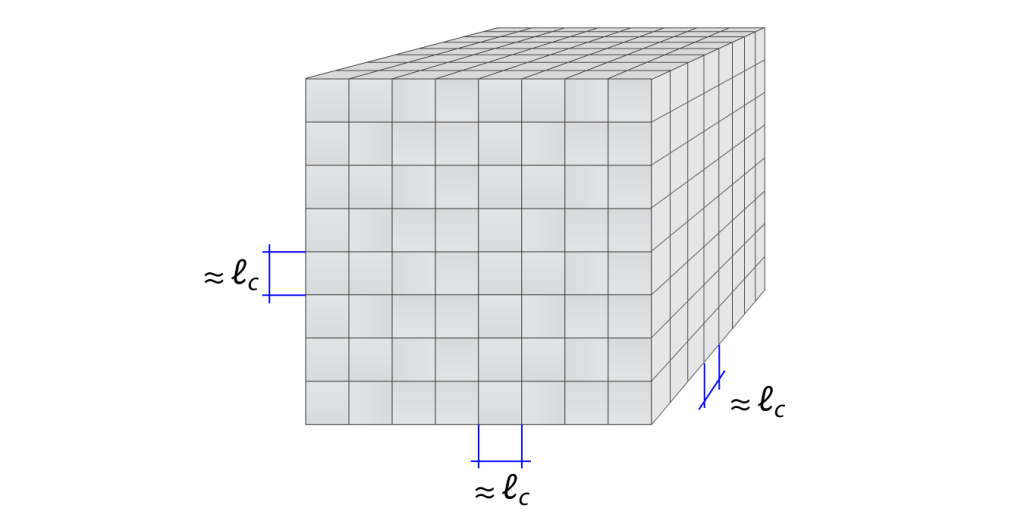
figure 1
Recent observations with the JWST have showed that the amount of available energy in the primordial universe was much higher than today. Actually it is in line with the assumption of the ΛCDM that the amount of cold Dark matter – concentrated free energy (see previous post) – was more abundant in the early universe. The evolution of the first UV-bright galaxies – about 300 million years old like the galaxy JADES-GS-z13-1-LA[2] – has showed that the rate of the evolution in the early universe was not equal to what we see today nearby our own galaxy, the Milky Way. So what is the mechanism behind this observation?
Figure 1 shows in a schematic way the structure of the volume of the universe. So it doesn’t mean that our universe is tessellated with real cubes because the image represents the geometrical foundations of our universe. That means that the structure must have a metric (ℓc), it must tessellate the volume of the universe – build up by smaller units with invariant volumes – and every unit of the structure must have identical basic properties.
Figure 2 shows a part of the lattice of the scalars of the Higgs field. The Higgs field exists everywhere in the universe and it is undeniable that the Higgs field has a structure. So if I relate figure 1 with figure 2 it is reasonable to suppose that every unit must have some kind of an internal spherical shape forming mechanism inside. The only real 3D scalar is the sphere so it is easier to use the term scalar mechanism.

figure 2
In macroscopic reality the strength of a material spherical shape depends on the closed boundary (shell) and the size of the boundary. That means that I can express the internal build up of the scalar mechanism of every unit with the help of an infinite amount of concentric shells. Each shell with a slightly larger radius. See figure 3.
Figure 2 shows 2 different configurations of sphere packing (Kepler’s conjecture). I have drawn both configurations in figure 3. The spheres are drawn in cross section so the imaginary “shell structure” – concentric shells – is visible. Showing the large differences between the empty space in between the scalars of both configurations.
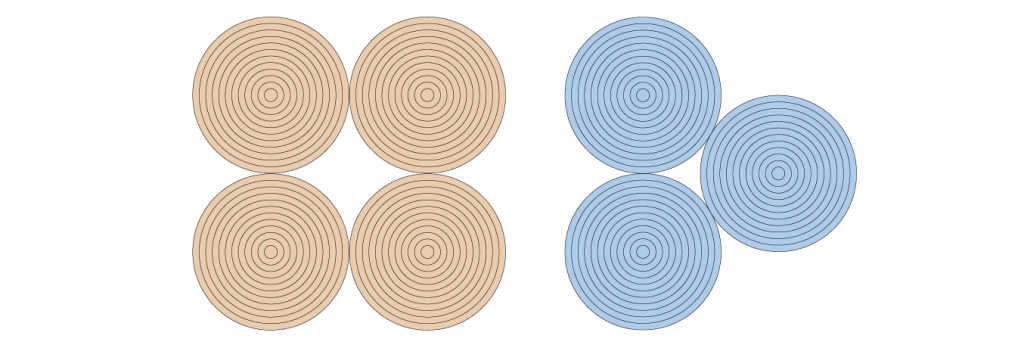
figure 3
But in spite of this all, the units of quantised space – figure 1 – tessellate the whole volume of the universe. The consequence is that every unit must be a deformed scalar to “drive out” empty space. But figure 3 shows that pressing the spheres together cannot fill the empty spaces in between the spheres in a symmetrical way. The latter means that the result represents a geometrical shape that have identical faces. Like figure 4.
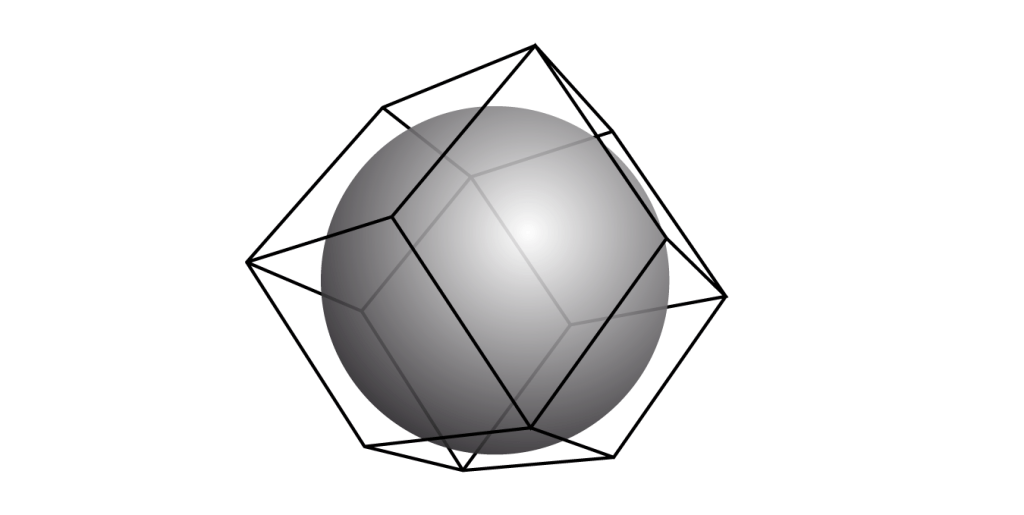
figure 4
The image in figure 4 shows a rhombic dodecahedron. It can tessellate space and if I duplicate the object many times I can build the scalar lattice in figure 2 with the inscribed spheres of these identical rhombic dodecahedra. However, figure 3 shoes that pushing identical spheres together cannot result in the creation of identical rhombic dodecahedra. Because half way the compression of the spheres the empty space in between the blue spheres in figure 3 is totally filled with the volume of deformed shells while there is still empty space between the brown spheres. The consequence is that there is a displacement of the volume of the outer shells in relation to the build up of the internal scalar mechanism at the start. Figure 5 explains why.
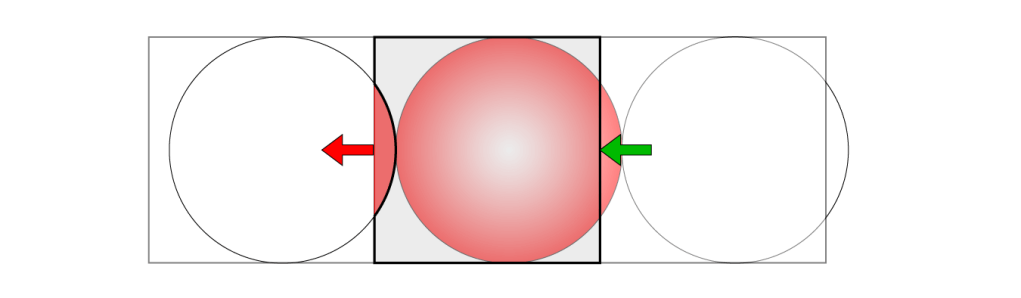
figure 5
The volume of every unit is invariant. So if the deformed volume of a unit is pushed to one side – the green arrow in figure 5 – its deformed volume will effect the unit at the left in exactly the same way (red arrow).
Moreover, this simple example of topological deformation shows that the increase of the surface area of the unit in the centre is equal to the surface area of the “bare part” of the scalar inside the unit. That is why we have to conclude that the surface area of the deformed part of the unit is invariant too. At least if all the units around have scalars inside with identical radii. Now I can draw the conclusion that the deformed part of the unit still has some kind of a homogeneous structure (equal density of its deformed volume). Now back to the situation during the compression of the spheres in figure 3.

figure 6
If the radius of the inscribed sphere (scalar) of all the units with a flat scalar field is r = 1,0 the radius of the undistorted spheres in figure 3 is r = 1,105. See figure 6. Radius r = 1,0 is the situation that all the empty space in between the brown spheres in figure 3 is filled too. So less than half way the compression of the spheres in figure 3 the empty space in between the blue spheres is filled. That is the black dotted line in figure 6.
Deforming the volume of the spheres in figure 3 even further will create a not equal distribution of the scalar mechanism inside the scalar itself (see the vectors in figure 7). Because the deformed scalar mechanism at the dotted black line has already filled the empty space in between the blue spheres but the space in between the brown spheres is not totally filled (red line). The consequence is that the deformed part of the volume cannot “close” the empty space in between the compressed spheres in a symmetrical way (like the symmetry in figure 4).
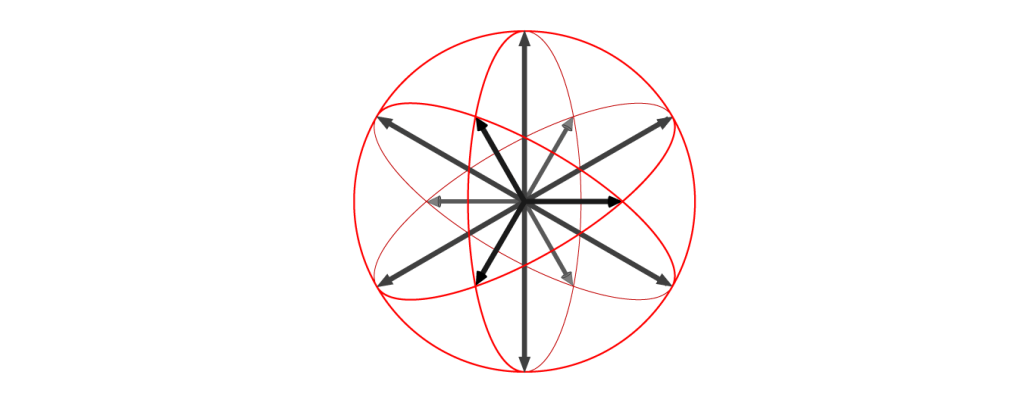
figure 7
But what I have described above about the asymmetry of the scalar mechanism (figure 7) is the usual geometrical reality of the universal electric field – the deformed part of every unit – and the corresponding vectors mediated by the points of contact between the scalars (figure 2 and figure 7). See the descriptions in reference 3 and/or 4. In other words, the amount of surface area of every unit of quantised space “at the supposed start of the universe” is larger than the surface area of a rhombic dodecahedron with exactly the same volume.
The amount of volume of every unit is identical and invariant. The consequence is that the difference between the average amount of surface area of all the units and the surface area of this rhombic dodecahedron represents the amount of energy that is constantly redistributed between all the units of quantised space.
The topological deformation (energy) of every unit during the constant of quantum time (tq) is synchronised and therefore the topological deformation is quantised (the Planck constant h). The scalar mechanism of every unit tries to minimise the surface area of the unit. Thus a local concentration of energy is only possible if a large amount of units transferred some of their individual topological deformation to the local concentration. Just set theory.
Dark energy
The linear propagation of a quantum of energy within the structure of the universal electric field is the speed of light (c). Figure 8 shows the diagram of an electromagnetic wave and the x-coordinate shows the direction of the electromagnetic wave in vacuum space. The wave form represents the action/reaction of the quantum of energy in relation to the topological deformation of the units around.

figure 8
If more and more units of quantised space transfer a part of their topological deformation to local concentrations of energy (matter) the amount of topological deformation of the units in vacuum space decreases. The consequence is that the action/reaction of vacuum space decreases too. In other words, if a photon (figure 8) was emitted 13,7 billion years ago and its wave length is measured now the wave length has increased (red shifted).
Thus the origin of the non-Doppler red shift of the light of distant galaxies doesn’t originate from the expansion of vacuum space. It is the result of the continuous concentration of energy by the scalar mechanism of all the units of quantised space.
During the evolution of the universe the surplus of surface area between the average surface area of the units and the surface area of the rhombic dodecahedron gets smaller and smaller. That means that the concentration of the same amount of energy will cost more time than 13,7 billion years ago. Because the number of involved units to create the same mass have to increase.
That is what astronomers observe in relation to the rate of the birth of new stars during the evolution of the galaxies. It shows a decreasing rate of energy concentration towards the present. In other words the non-Doppler red shift has increased. Therefore, the increase of the wave length of the non-Doppler redshift is not linear with the increase of trajectory of the electromagnetic wave. Because the speed of light is a universal constant.
Conclusion
The term “Dark energy” is misleading. Because the increase of the observed non-Doppler redshift of the light of distant galaxies during the evolution of the universe is caused by the decrease of free energy in vacuum space. A deficit of energy that is equal to the local surplus of energy by matter. That is why vacuum space doesn’t expand and the non-linearity between the red shift and the length of the trajectory of light is the consequence of the continuous concentration of energy in our universe.
References:
- 2024); “Is discrete space not isotropic?”
https://zenodo.org/record/11655406 - Joris Witsok et al. (2024); “Witnessing the onset of reionization through Lynman-α emission at redshift 13”
Nature Vol 639 (27 March 2025) 897
https://doi.org/10.1038/s41586-025-08779-5 - (2024); “On the geometrical structure of quantised space”
https://zenodo.org/record/14556269 - (2020); “On the construction of the properties of discrete space”
https://zenodo.org/3909268

