It is for sure that there are possibilities to research the properties of the displaced vectors that dominate the emergence of (human) consciousness. But it needs some insight to focus on the right phenomena in relational reality to draw verifiable conclusions. Nevertheless, there are already known “phenomena” that are verified in scientific research. Like the probability of the distribution of the qualities of human consciousnesses.
We know that we are consciousness because we have experiences. Actually, consciousness is experiences, no matter the mechanism behind the existence of consciousness. One of the qualities of human consciousnesses is intelligence. However, what we have termed intelligence is a mixture of different related qualities. So at least we can split up intelligence in 2 categories: social intelligence and cognitive intelligence. Note that social intelligence is dominated by handling emotions and cognitive intelligence is dominated by handling thoughts. Both main facets of intelligence reflect the correspondence between the universal electric field and the magnetic field.
Cognitive intelligence is tested worldwide (the IQ test) and it shows that the distribution of the human IQ is in line with the normal distribution (see Wikipedia image IQ distribution, figure 1). The distribution of all the other human qualities are not tested worldwide in a standardized way. But it is obvious that we can assign the same normal distribution to nearly every human quality (e.g. musicality, artistry, decisiveness, speaking skills, etc. etc.).
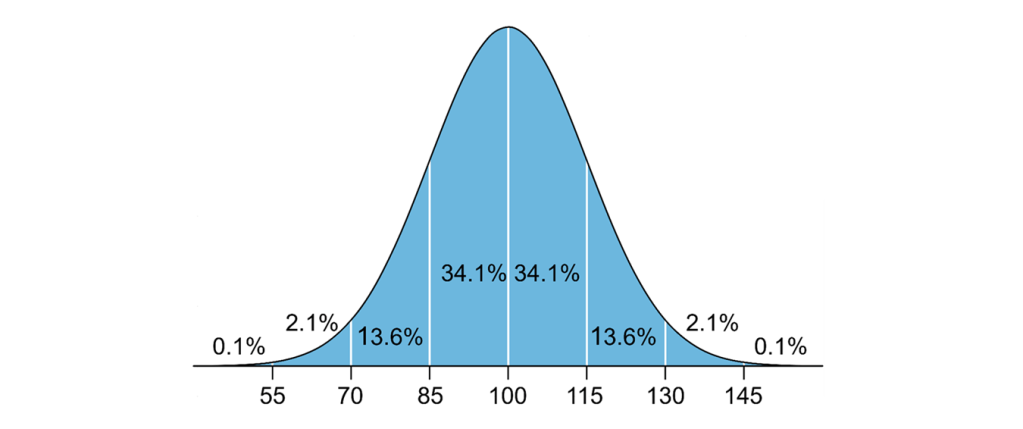
figure 1
Now what does this really mean? Unfortunately not so much, because probability[1] originates from the transformation of the shapes of the units of quantized space under influence of the scalar mechanism.[2] In other words, we will find the normal probability distribution everywhere in the universe under approximately stable conditions.
The diagram in figure 1 shows a linear increasing IQ score. They made the choice that the average IQ score = 100. That means that on average 68,2 % of all the tested people have an intelligent quotient between 85 and 115. However, there is a relation with health issues. For example, drinking water that is polluted with lead on over a long period of time – especially during growing up – will lower the average IQ score.
If we use the normal probability distribution for every human quality and use the linear score of 0 => 100% we can describe a person with the help of his/her personal scores of all the distinct qualities, inclusive the IQ quotient. Some of these qualities will be > 50% and other qualities < 50%. Of course, we live in an evolutionary universe so it is obvious that the different human qualities will show some changes too during a long period of time.
Some qualities are dualities. For example happiness and sadness. We cannot be sad if we are happy and visa versa. And on average a cheerful person is seldom sad, while a gloomy person is seldom happy. If we think about these dualities, it seems that there is some kind of “conservation of dual qualities”. Because there exists balance between these dual qualities too. However, it is impossible to isolate these dualities from the conditions around. Even a cheerful person isn’t happy if it is cold, windy and it is raining too. And more worse, there is no shelter nearby. But what about the dual qualities that are influenced by the same dual qualities of other people?

figure 2
Egoism and altruism are dual human qualities. Because we know that we are not always altruistic, we are egoistic too. But the total amount of altruism and the total amount of egoism is conserved. The diagram on top of figure 2 shows the probability distribution of human egoism and the diagram at the bottom shows the probability distribution of human altruism. Both qualities are a duality so the percentages in both diagrams are reversed. Egoism from 100% to 0% and altruism from 0% to 100%. The vertical black arrow indicates the number of people of the total group of people who share the same score. Now what does it mean in the practise of everyday live?
If 2 qualities together form a duality no human can claim that the duality isn’t part of his/her experiences. That means that if person A has an average of 38% altruism, he/she has an average of 62% egoism too. And if person B has an average of 68% altruism, its egoism will have an average of 32% (see figure 3). However, what is altruism and what is egoism? In general altruism is the concern for the well-being of others (sharing) and egoism is the concern for the well-being of the personal self (taking).
In our culture we have the opinion that altruism and egoism are properties that are part of the human soul. So it defines the quality of the soul (egoistic person or altruistic person). Personally I don’t know exactly what the soul is but it is reasonable to interpret the term as the kernel (basic properties) of the manifestation of consciousness in relation to everything around, inclusive the material body. But if I relate egoism and altruism directly to the existence of the soul it “smells” like altruism and egoism are actually basic properties of the soul. Like every material object has a mass and the amount of mass defines the motion of the material object (in relation to the conditions around). But is that true?

figure 3
Altruism and egoism have only a clear meaning in relation to interactions between humans. In relation to animals and plants we don’t use the same terms but of course there is a direct connection. Anyway, the topic is about the origin of egoism (taking) and altruism (sharing) and the natural balance between both. The latter is the consequence of the universal conservation of change (energy and corresponding vectors).
The mechanism that is responsible for all the changes in the universe, is the same mechanism that was responsible for the creation of matter. The difference between both “states” is the threshold of the local energy density because a universe without matter is still a non-local universe. So we are talking about some kind of an enormous fractal. That means that at a certain moment the energy distribution everywhere in the universe facilitated the excess of the threshold. The result is the disruption of the homogeneous universal scalar field (the emergence of decreased scalars). However, the same mechanism is responsible for the absence of true geometric symmetries in the universe. Note that a universal conservation law isn’t also a true symmetry.
So it is obvious that the duality egoism and altruism in figure 3 must have a threshold too. Because it is difficult to imagine that in the long term a person is perfectly 50% egoistic and 50% altruistic. The consequence is that if a person passes the 50% – 50% threshold he/she experiences more egoism than altruism or the opposite. That means that we don’t “drift” easily over the 50% – 50% threshold. That is in line with our struggle to change how we experience our “inner self” (happy/unhappy, etc., etc.). In other words, our personal “fixed” experience of egoism and altruism is the result of the “fixed” experience of egoism and altruism of all the others. Because the further away our experience is from the 50% – 50% threshold the more likely it is that we “choose” to be more egoistic or more altruistic in relation to others.
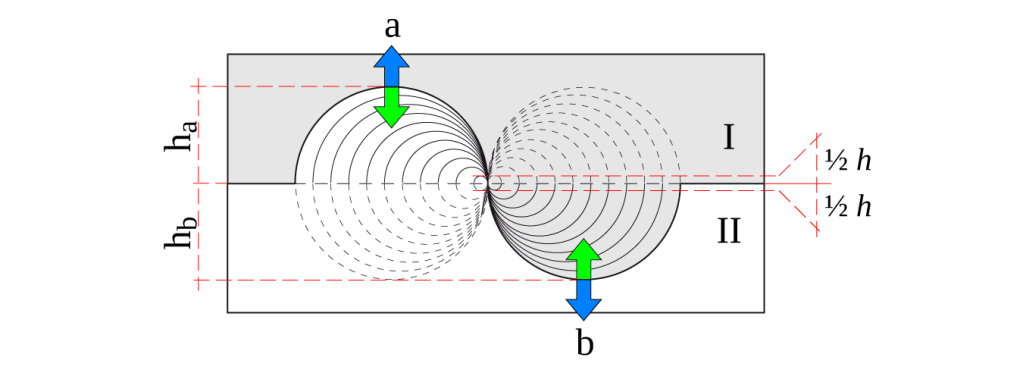
figure 4
Vectors – inclusive displaced vectors – are the result of the synchronised topological deformations of all the units of quantised space under invariant volume. That means that the total amount of deformation is the result of a basic duality. Figure 4 shows the schematic principle of the topological deformation of 2 rectangle bodies under invariant volume (cross section). The flat joint face of the bodies I and II – horizontal dotted line – shows the same type of threshold. If we deform the joint face in the direction of body I (blue arrow), we have to deform simultaneously the joint face in the direction of body II (blue arrow). So we cannot change the deformation of body I without changing simultaneous the deformation of body II and visa versa.
Conclusion
Dual experiences like egoism and altruism originate from the basic properties of the structure of quantised space. These dual experiences are dominant in the interactions between the participants in human society. Unfortunately the structure of our present culture is the result of our social and cognitive intelligence during a long period of time. A society that is not aware of the existence of the duality. That is why we put our energy in the effort to increase our preferred situation (the “good” ones) in order to eliminate the other situation (the preferred situation of the “bad” ones). So we are quite busy with carrying water to the sea.
References:
- (2021); “The mechanism behind probability”
https://zenodo.org/records/5515861 - (2024); “On the geometrical structure of quantised space”
https://zenodo.org/records/14556269

