Cantor’s set theory gives insight in the dynamical relations of our universe. Because if we measure the relations between 2 phenomena, we are measuring what type of properties both phenomena have in common. For example weight. Figure 1 shows the situation with the help of a Venn-diagram. The image shows the properties of phenomenon A (yellow) and the properties of phenomenon B (blue). The intersection A∩B (green) shows the property both phenomena have in common.

figure 1
If we look around in daily reality we observe that there are no phenomena that exist totally independent from other phenomena. The observation suggests that all the phenomena are part of a large reservoir of shared properties. Thus phenomenon A and phenomenon B are part of an all-inclusive phenomenon C (reddish) that envelopes everything. So I have to expand figure 1.

figure 2
The Venn-diagram in figure 2 looks nice but if I think about the diagram it seems that something is wrong. Because how is it possible that phenomenon A and phenomenon B have an intersection while all the properties are shared properties that “belong” to phenomenon C? Actually, phenomenon A and phenomenon B are manifestations of phenomenon C. In other words, figure 2 is wrong. The correct Venn-diagram is figure 3.

figure 3
Figure 3 shows that phenomenon A and phenomenon B emerge from phenomenon C. The Venn-diagram in figure 1 is actually showing an interaction between both phenomena. So the question arises “What is phenomenon C?”
Phenomenon A and phenomenon B are observable. They are tangible or at least measurable. But phenomenon C isn’t observable and measurable at all. Because it is a construct with the help of reasoning. It raises the question if there are other points of view that show this contradiction.
Suppose I focus on the “tangible” phenomena. So I can imagine that I concentrate all the phenomena in the universe. If this is possible I have created a clear partition of the whole universe. One part envelopes all the phenomena and the other part envelopes… well that is the question. Figure 4 shows the 4 possibilities in relation to the existence of reality. A grey raster means that it is part of reality, without a raster it is not.
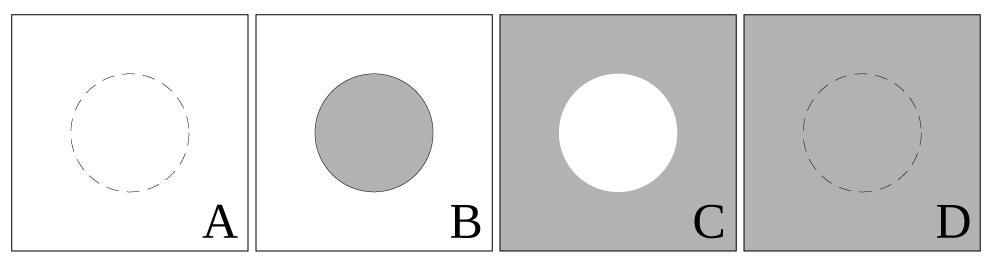
figure 4
Possibility A suggests that the phenomena are not real and the background either. The next possibility (B) shows a reality that seems to align with the ideas in classic physics. Phenomena exist in an emptiness and the relations between the phenomena are the manifestation of their individual properties. Possibility C is not familiar to humans because humans are phenomena too. Thus the idea that phenomena don’t exist, except the background, is really awkward for humans.
The last possibility (D) represents everything that exists. There is no difference between the phenomena and the background of the phenomena. Thus reality envelopes the phenomena and the background of the phenomena. Possibility D envelopes the other 3 possibilities too so logic tells us that possibility D is the correct representation of the existence of reality in our universe. Unfortunately it is also an abstraction, like the Venn-diagram in figure 3. Because we don’t observe an all-inclusive reality, we observe possibility B (phenomenological reality).
Modern physics has examined possibility D. Theoretical physicists have concluded that possibility D exists in the form of basic quantum fields (QFT). It is thought that the properties of these quantum fields – phenomena on their own – create all the other composite phenomena. This concept raises a question about the reality of the basic quantum fields. Because if quantum fields are phenomena, what creates these quantum fields?
There is more confusion because space itself curves under influence of matter – Einstein’s theory of General relativity – thus we have to conclude that spacetime is a phenomenon too. The curvature is thought to create what is interpreted as “gravitation”, thus the assumption that the properties of the basic quantum fields are responsible for the emergence of all the phenomena is not 100% correct.
In theoretical physics it is thought that space itself is homogeneous and isotropic. At least at the scale size that humans can examine. This seems not in line with spacetime but the point is that the curvature of space isn’t observable. What we observe are the mutual influences between the phenomena. So at the end Einstein’s spacetime shows to be an abstraction too.
The relation between all these points of view is that observable reality is phenomenological reality. But if we want to know the structure of phenomenological reality it shows that the structure is an abstraction. A model of reality that we cannot observe and measure in a direct way.
If we think about it – and the influence of the scientific method on physics as a science – the question arises if our interpretation of physical reality with the help of numerous experiments is a really straight forward method. Because if observable reality is actually relational reality there are far too much different configurations (phenomena) to examine, to interpret and to align against each other.
It is much easier to confine to the interpretation of the existing universal properties. That means properties that exist “at every point” in our universe. Like the quantum of energy (h), the universal speed of light (c), the law of conservation of energy, the law of conservation of momentum, the uncertainty principle (Heisenberg), the principle of non-locality, etc. Because it is easier to construct a model with the help of universal properties than a model “that fits all the experiments and observations”. Although one can argue that these universal properties show a high amount of abstraction too.
The text above is a compilation of parts of the contents of 2 papers:
- “The box without walls” (2024)
doi: 10.5281/zenodo.14540104 - “Empiricism and empirical information” (2019)
doi: 10.5281/zenodo.3592378
