
If phenomenological reality is not the source behind everything that exist and evolve, the question raises what creates phenomenological reality. Because if phenomenological reality is not its own creator, what creates phenomenological reality?
Our senses are not limited to our eyes. However the most detailed information that we can detect with our senses comes from our capacity to see electromagnetic waves (the visible frequencies). The integration of all these signals from around creates an image that shows itself as a geometrical reality. Not a static geometric picture but a dynamical one.
Geometry is about volume, surface area (the boundary of the volume) and points and lines too. The latter is a bit fuzzy because every point and line in observable reality has a volume and a surface area too.
If we think about the classification of the properties of geometrical objects in 3 dimensions it raises the question why the classification doesn’t show a direct relation with structure. Because everything we observe has structure. If structure underlies the dimensions of geometrical objects – trees, houses, animals, the planet, etc. – we have to conclude that dimensional geometrical objects emerge from a geometrical “background” structure (an immovable rest frame). A structure that manifests itself as the universe.
An all-inclusive geometrical structure is build up by units (the elements of a set). Like the schematic image in figure 1. All the units of the structure must have identical basic properties otherwise smooth transformations are not possible. Transformations we have termed ‘evolution’ in phenomenological reality. In line with Newton’s axioms about absolute space and absolute time.
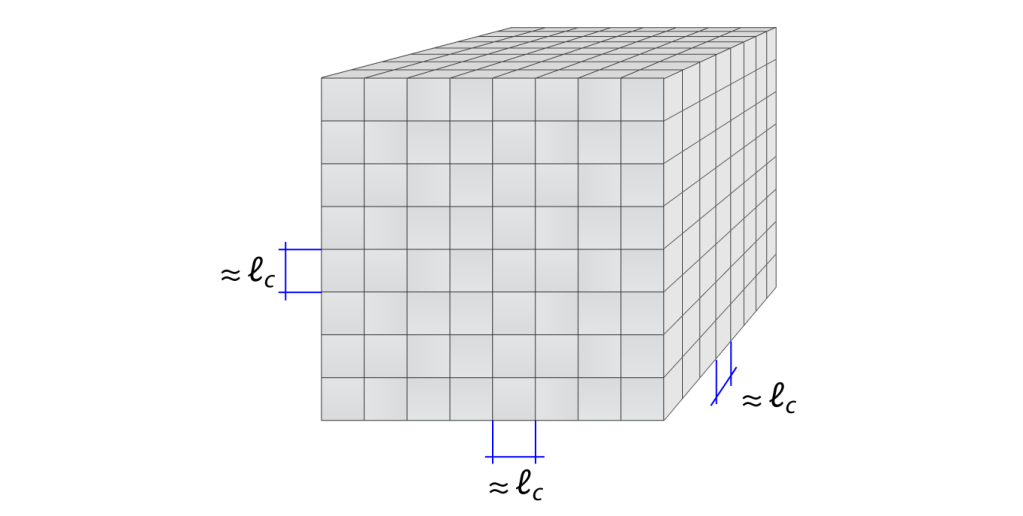
figure 1
Suppose the units of the structure are infinite small. The consequence is that there cannot exist a differentiation between the units. But phenomenological reality shows differentiation. That is why we have to conclude that the units of the structure must have a fixed size. A fixed size means that the units are indivisible (“atom” in ancient Greek). To create indivisibility it is necessary that every unit has an equal and invariant volume. A continuous transformation (deformation) under invariant volume is part of the area topology in mathematics.
[An invariant volume means that a unit – see figure 1 – can only change its shape because the amount of volume of the unit is a constant.]
Every unit that tries to change its shape will discover that change is only possible if all the other units of the structure change their shape synchronously. Moreover, changing the shape of a geometrical object under invariant volume means that the unit has to transfer volume within the boundary of the unit itself. Think about it.
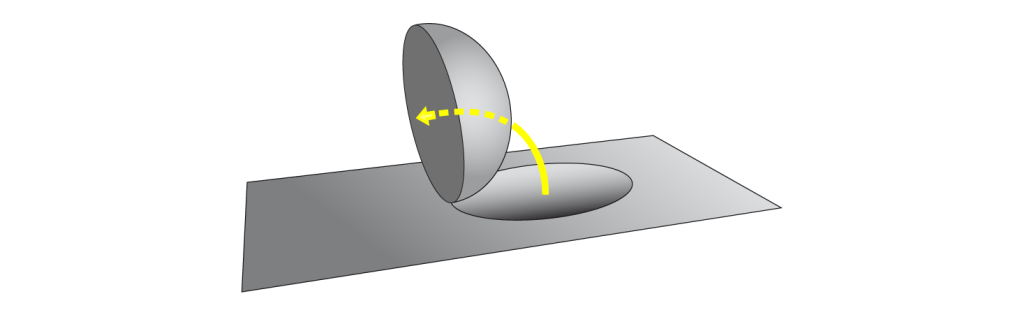
figure 2
If I take a scoop of ice cream and put it down on the flat surface I have created a transformation under invariant volume. It is obvious that the deformation of the flat area has increased the amount of surface area of the ice cream. However, figure 2 represents phenomenological reality thus we don’t interpret the new surface area of the ice cream as a joint area. But I can draw a cross section of 2 rectangle bodies of ice cream and the joint area is comparable with figure 2.
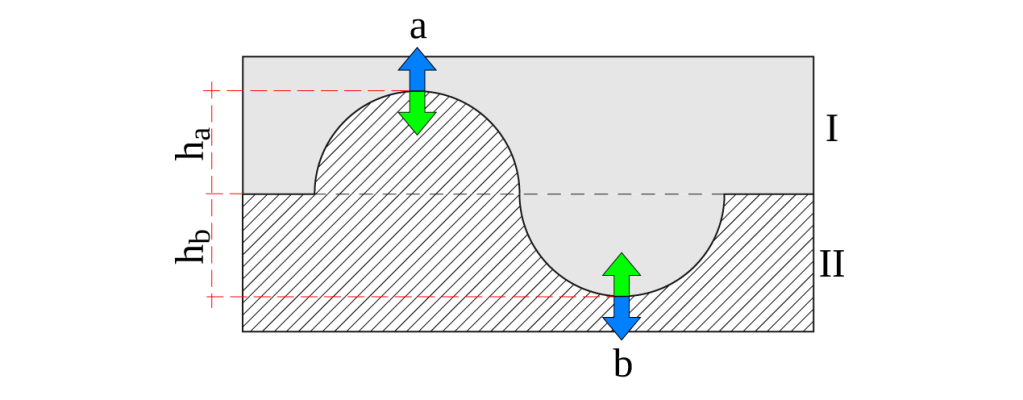
figure 3
If my point of view is object II the deformation in a is a surplus of volume and the deformation in b is a deficit of volume. Of course volume II is equal to volume I because the deformation of the joint surface area between both rectangle bodies is a topological deformation under invariant volume. Thus if I want to increase the deficit of volume (b) I have to increase synchronously the surplus of volume (a). The deformation in figure 3 is a symmetry therefore hb = ha.
Figure 4 clarifies figure 1. Because the image shows that the deformation of the shape of the units is only possible if the joint surface area of all the units is larger than the minimal surface area for the invariant volume (a sphere). But it also shows that every local deformation of the universal electric field – like the Planck constant (h) – is the sum of a local deficit and surplus of energy (2 x ½ h).
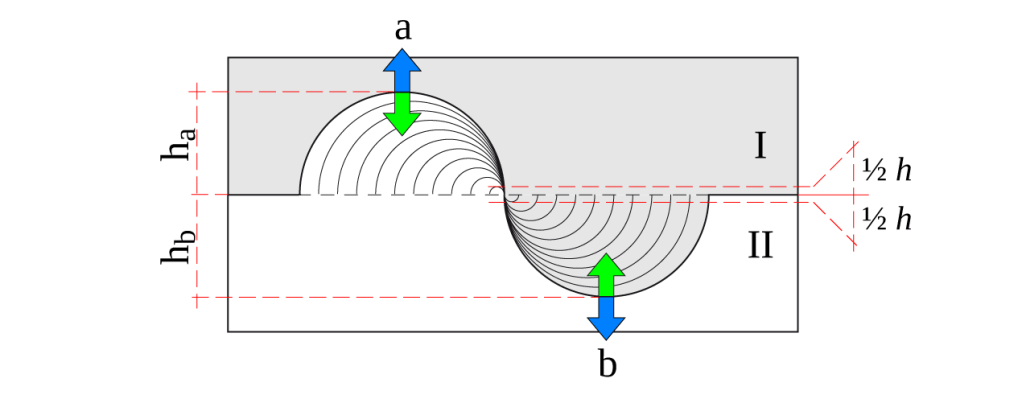
figure 4
If every unit changes its shape synchronously every unit is forced to transfer internally the same amount of its volume. And the amount of transferred internal volume determines the duration between the shape of the unit at the start of the deformation and the shape at the end of the deformation. And because of the synchronization every unit transfers the same amount of volume during the same duration of time. In other words, there is a direct relation between the shape of a unit and the amount of transferred volume – actually a flux of infinite small “grains” – to create the shape.
A geometrical body that is part of a structure – like the small cubes in figure 1 – has more than 1 joint area because there are more than one adjacent unit. Therefore the transformation of the shape of a unit – with the help of the transfer of a flux of infinite small “grains” of volume inside the boundary of the unit – is only possible if Vinput = Voutput.
However, the total amount of transferred volume of all the units together is conserved (law of conservation of energy). The consequence is that the total amount of surface area of the units is conserved too. It raises the question what kind of mechanism is responsible for the transformations.
