
The previous post derived a couple of basic properties that exist if the universe has a geometrical structure. It raises the intriguing question why modern theoretical physicists didn’t recognize the existence of the geometrical structure. Was it impossible for theoretical physicists to discover the geometrical structure? A decade ago I asked myself the same question so I started to think about it.
If our universe has a geometrical structure – like Zeno of Elea explained in his paradox about Achilles and the tortoise – the evidence of the structure must emerge from the properties of vacuum space itself. Because nearly the whole volume of the universe is vacuum space.
Physicists are familiar with the properties of vacuum space at the smallest scale size because vacuum space is known for the existence of a limited number of basic quantum fields. These basic quantum fields are mathematical fields and represent vectors, scalars and topological spaces. Thus there is a vector field (magnetic field), a scalar field (Higgs field) and a topological field (electric field). Figure 1 shows an impression (grey scalars, black resulting vectors and a blue topological field in between the scalars).
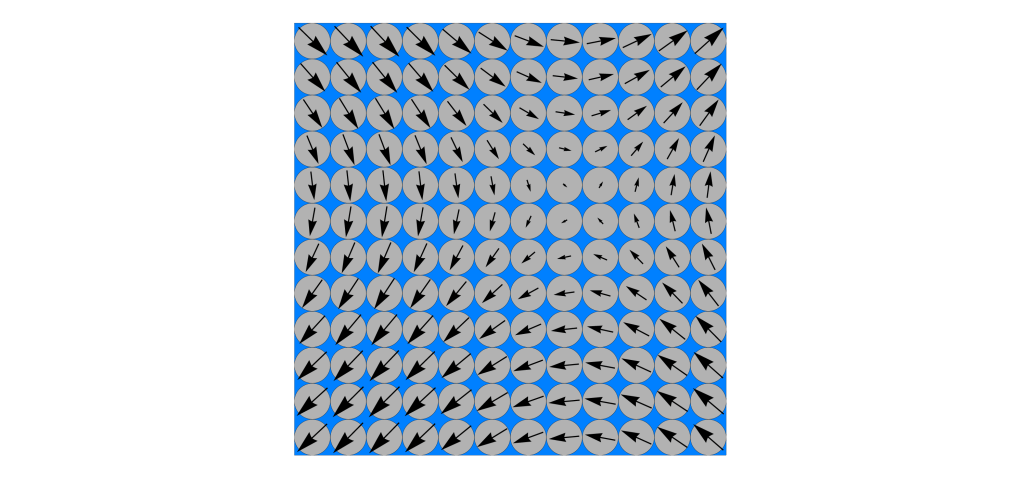
figure 1
If a field is totally flat – every point in space has exactly the same magnitude – it is impossible to measure the properties of a field. Thus fields are known because there exist local disturbances. Like electromagnetic waves that arrive from every direction.
In 1900 Max Planck derived a formula about the energy of electromagnetic waves that is in line with the measurements. It is the well known formula E = h v [h = the Planck constant; v = the frequency]. A couple of years later Albert Einstein showed that the speed of light is a constant (c). Both results can be combined (the Planck-Einstein relation):

In the equation the frequency (v) of the electromagnetic wave is expressed with the help of the speed of light (c), divided by the wave length of the electromagnetic wave (λ). If we think about it the equation seems awkward. Because E is a multiple of h and the latter is a universal constant. The speed of light is a universal constant too. Thus the only variable in the equation is the wave length. That cannot be true because it means that there exists variance in between universal constants that determine all the properties of an electromagnetic wave.
The solution is a new expression of the wave length (n ℓc) and ℓc stands for the universal constant of length. Note that the revised Planck-Einstein relation shows only universal constants. In other words, the universal constant of length (ℓc) is a manifestation of the geometrical structure of the universe. Its existence was already explained by Zeno of Elea some 2500 years ago. It is the same metric that I used in the schematic figure 2 (see previous post too).
By the way, the Planck-Einstein relation underlies Einstein’s formula E = m c2 because matter (m) and anti-matter annihilate each other and the result is the emergence of a couple of high-energy electromagnetic waves (e.g. the annihilation of a proton and an anti-proton).
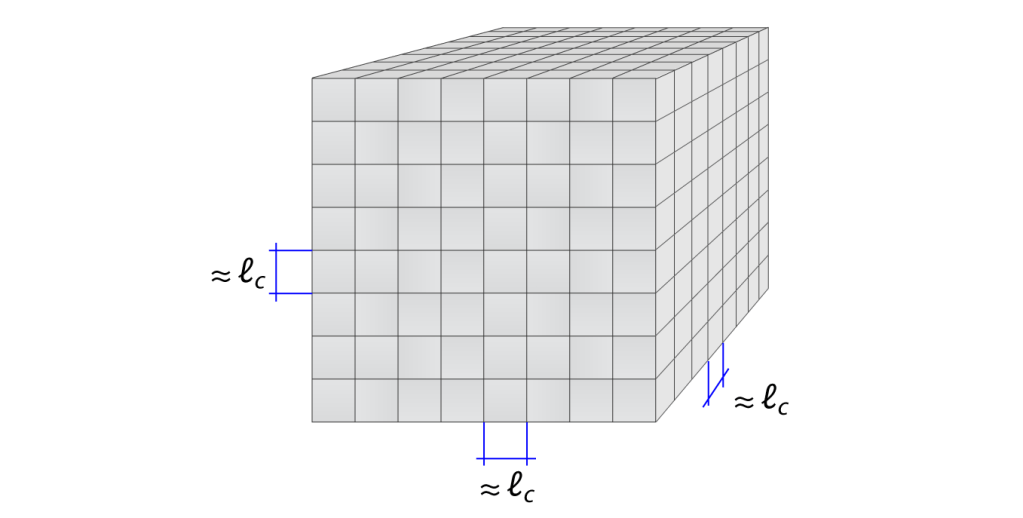
figure 2
There is no doubt that our universe has a geometrical structure although the structure is not observable in a direct way. We can derive some basic properties – see previous post – but it is difficult to visualise its existence if one or more basic properties are unknown. So we must focus on figure 2 to understand which property is missing.
Every unit (small cube) has the same invariant volume, therefore it is reasonable to speculate that every unit can change its shape. Actually the change of shape shows to be a topological deformation under invariant volume (previous post, figure 3). The boundary of every unit is a joint boundary. Thus the basic property that is still missing is the mechanism that is responsible for the continuous topological deformation of all the units.
I can compare the schematic figure 1 with the schematic figure 2 and the result is figure 3. It suggests that every unit of the geometrical structure of the universe represents all the known quantum fields. Thus a part of the volume of a unit is a scalar, the remaining volume is the topological field and the 1-dimensional vectors are mediated by the flat scalar field (the ultimate proof is Newton’s cradle).
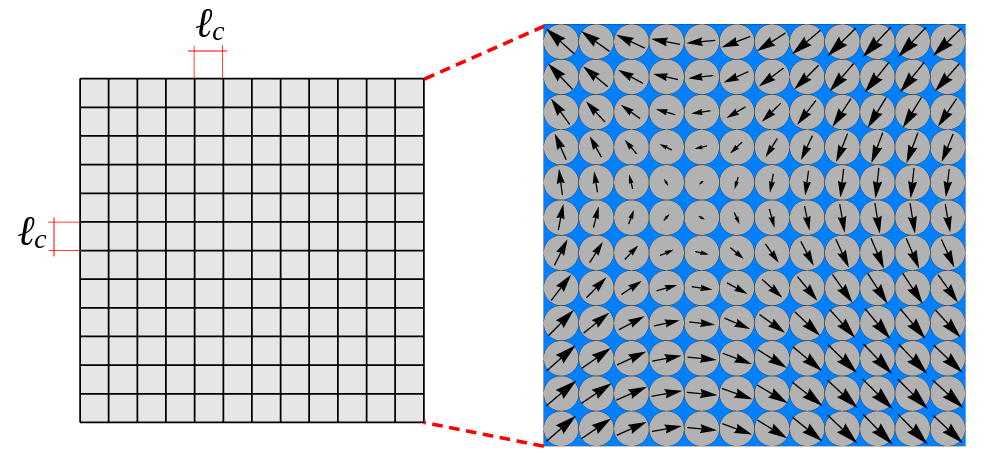
figure 3
There is a different approach too. Figure 2 shows a 3D display because the variances between the “pixels” generate configurations of mutual influences that can only be interpreted as a self generating fractal. The consequence is that there exist a dominant shape everywhere within the structure (the universe). We know the dominant shape because it is the self-similarity of the sphere (the only true scalar in geometry). The consequence is that every unit (“pixel”) must have an internal spherical shape forming mechanism.
Figure 3 shows the relevance of the conclusion because the volume of every unit has 2 distinctive parts: a non-deformed part (the scalar) and a deformed part (the electric field). If we calculate the amount of volume of each part the volume of the scalar is about 74% of the volume of the unit and the deformed part about 26% (see the green “box” in figure 4).
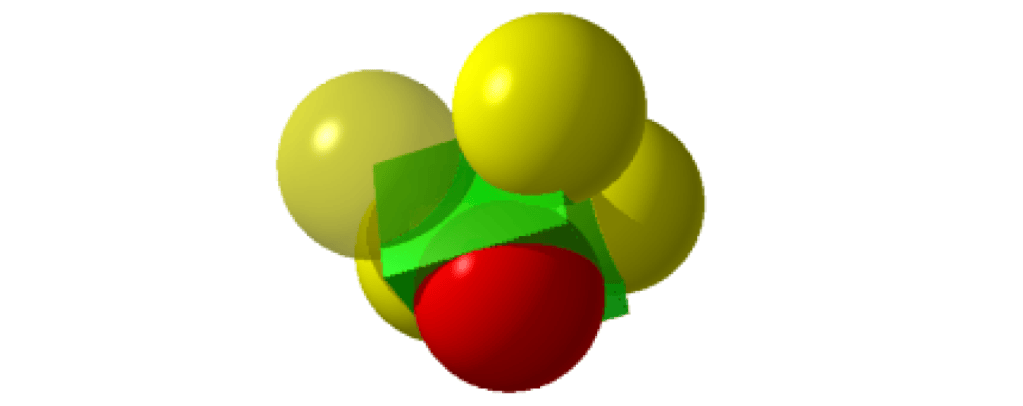
figure 4
All the scalars of the flat Higgs field together form a lattice and the lattice is known as Kepler’s conjecture. Figure 5 shows why Kepler’s conjecture is the only possible scalar arrangement because it mimics isotropic space for every unit. The red lines connect the point of contact between adjacent scalars. In vacuum space every scalar has exactly the same radius and it creates the 1-dimensional mediation of influences that we have termed ‘vectors’.
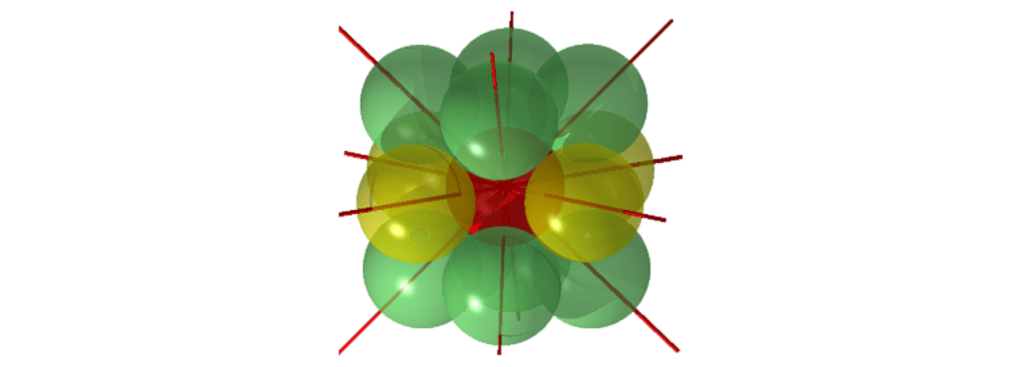
figure 5
The rectangle scalar arrangement in figure 4 is clearly visible in figure 6. There are only 2 repeating layers of the rectangle arrangement thus it is easy to calculate the ratio between the volume of the scalar and the volume of the deformed part of the unit. The triangle arrangement has 3 repeating layers (layer d = layer a).
Because of the existence of the dynamical internal spherical shape forming mechanism of every unit it is clear that the lattice in figure 6 is determined this mechanism. In other words, the stability of a unit starts in its centre. The mechanism tries to expand the radius of the scalar and not the volume of the deformed part.
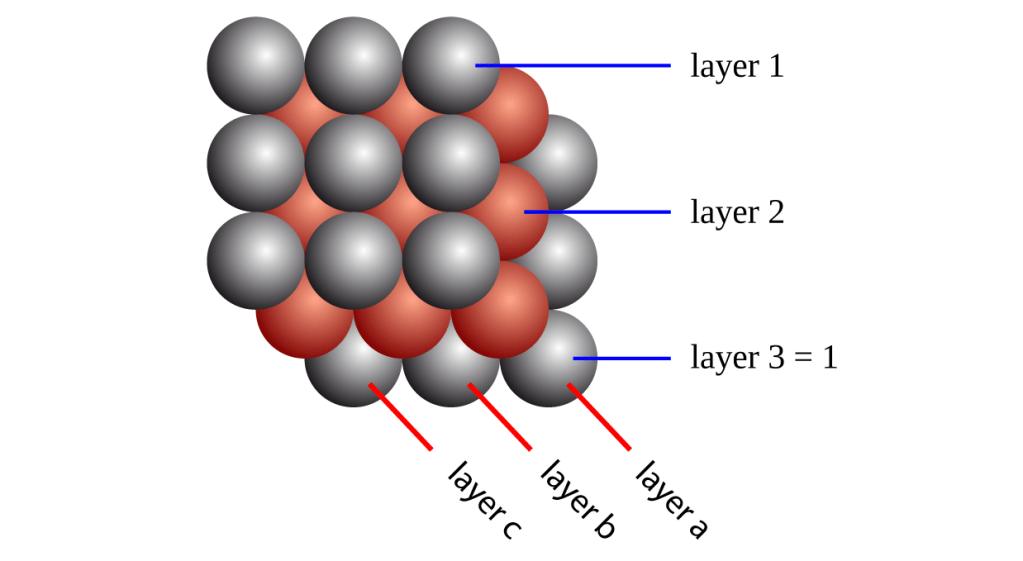
figure 6
Although the unit of quantised space seems to be an easy geometrical object, in practise it is quite complicated. That is why this post is not the last one that describes the geometrical properties of the unit. To prevent this website to become duller and duller I like it to create “excursions” to related scientific topics. Like the nature of time (next post).
A clear “picture” of the geometrical properties of the units arises when we imagine an enormous volume that is filled with identical deformable spheres. At a certain moment the whole volume is occupied by the spheres. Then we add more and more spheres to wipe out the empty space in between the spheres. The consequence is that we have to use pressure to deform the spheres. If there is no “free” volume left, the surface area of every deformed sphere is like a joint boundary with the adjacent spheres. But of course this is still a static “picture” of quantised space.

