
Wikipedia has a lot of information (pages) about the nature of time. Not only time as a phenomenon (physics) but also time as a philosophical subject. There are also a lot of Youtube videos about different interpretations of the nature of time by scientists. In other words, the problem hasn’t settled yet.
Isaac Newton wrote an axiom about absolute time (and common time): “Absolute, true and mathematical time, of itself, and from its own nature flows equably without regard to anything external, and by another name is called duration: relative, apparent and common time, is some sensible and external (whether accurate or unequable) measure of duration by the means of motion, which is commonly used instead of true time …”
Newton’s axiom describes time as a basic property of the universe as a dynamic continuum. In other words, absolute time as a property of the rest frame and common time as a relation (result) in phenomenological reality. Einstein’s relative time isn’t about the continuum, it is about the mutual relations between phenomena. Actually Einstein’s relative time is about the rate of change of phenomena under influence of a universal constant: the speed of light (c).
Unfortunately there is not only a problem of the interpretation of the nature of time in physics, time is also a human experience. Let’s term it “psychological time”. Sometimes humans experience that time flies and sometimes it shows to be slow. It is a experience but we cannot argue that humans exist “outside” the dynamical structure of the universe. Thus if time is absolute, why do humans experience time in a different way? And if time isn’t absolute, why do our clocks measure time as a sequence of equal duration?
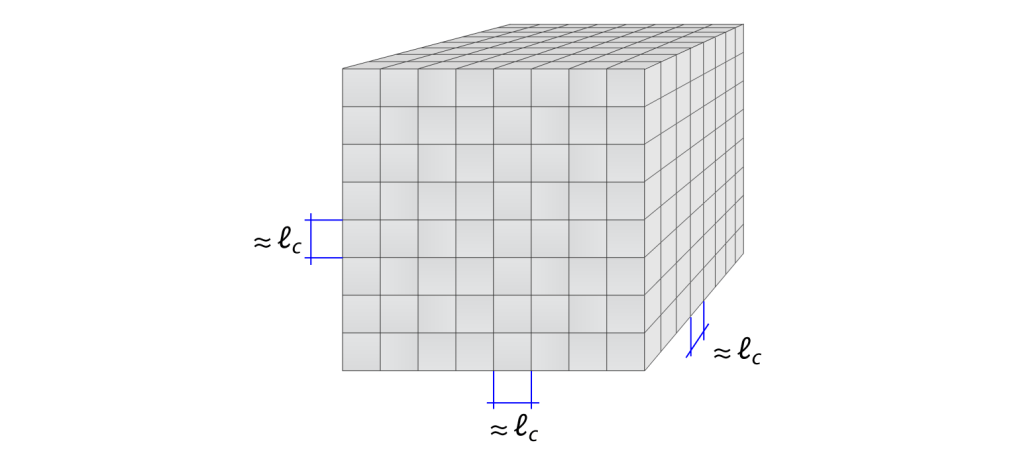
figure 1
The ongoing discussion about the nature of time is a discussion that shows the limitations of our present paradigm. Because most scientists are convinced that the nature of reality is just phenomenological reality. Unfortunately phenomenological reality manifests itself by the mutual relations between the phenomena. But if phenomenological reality is just relational reality, why do universal constants, conservation laws and principles exist? It is not in line with an all-inclusive reality that is only relational. And it contradicts the existence of structure at every scale size. Just look around, everything you observe has structure.
Figure 1 shows – in a schematic way – a volume that has a structure that is capable of continuous transformations. Not by changing the volume of the units but by changing the shapes (topological deformation under invariant volume). The consequence is that all the units of quantised space – the structure of the universe – are forced to transform their shape in a synchronised way. In a synchronised way means in a non-local way. Because the essence of non-locality is that everything in the universe influence everything in the universe at exactly the same moment.
Every unit of quantised space is surrounded by adjacent units and the boundary of the unit is a joint surface area with the adjacent units. Therefore if a unit transforms its shape under invariant volume the transformation is the sum of an external push (by one or more adjacent unit) and an internal push (towards one or more adjacent units). Synchronisation means that every unit starts a transformation at exactly the same moment and continue the transformation until there is a synchronised change in the configuration of the external and internal push. That means there is a change which external adjacent units will push during the next “cycle” and which adjacent units will be pushed by the unit itself.
The diagram in figure 2 shows the increase of the topological deformation of a unit. The grey rasterised area is the amount of energy (1 h) and the red arrows show the corresponding increase of the magnitude of the local magnetic field. Because the universal electric field and the magnetic field are corresponding fields.
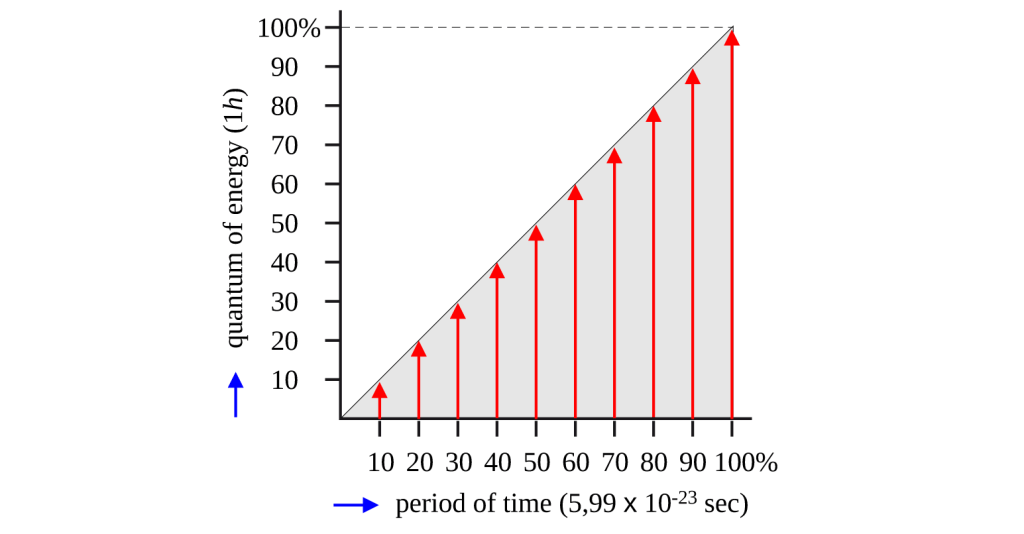
figure 2
The metric of quantised space is ≈ 0,5 x 10⁻¹⁵ m thus it is easy to calculate the duration of the linear propagation (c) of the quantum of energy (h) from one side of the unit to the opposite side. The outcome is the constant of quantum time (tq) and the duration is ≈ 5,99 x 10⁻²³ second.
In other words, there exists a constant of quantum time (tq) everywhere in the universe and the “flow” of quantum time is in one direction. Simply because the whole structure cannot transform under invariant volume in different directions. However, there exist “psychological time” too (see the text just above figure 1).
Figure 2 shows that every transformation of a unit under invariant volume creates corresponding vectors. The fixed amount of topological deformation – the grey area – propagates with the speed of light. But vectors don’t transfer energy, vectors are mediated by the 12 points of contact between the scalars of the units in vacuum space (see figure 3). Thus the universal electric field creates the local transformation – synchronised with all the other transformations – and the resulting vectors determine the direction of an influence. The consequence is that vectors act instantaneous.
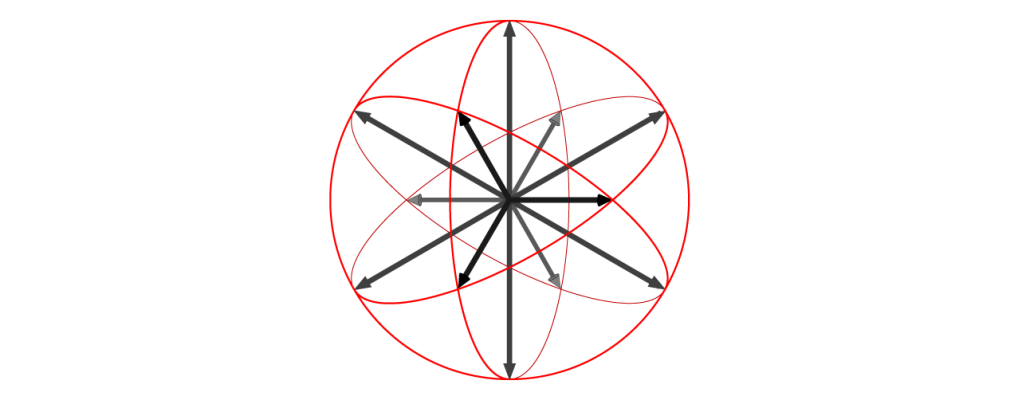
figure 3
The range of a vector is determined by the magnitude of the vector that is mediated from the opposite direction. It means that the “acting” position of the influence of a vector isn’t clear. Nevertheless, vectors are part of the human experiences too.
Vectors are created by the local transformations of the universal electric field (the deformed parts of the units of quantised space). Thus the creation of the change of a vector is in synchronization with the constant of quantum time (tq). But the position of the influence of the vector on the phenomena around isn’t clear. It clarifies why humans not only experience quantum time (tq) but also an asynchronity between the transformation in quantum time and the instantaneous influence in vector “time”.
