
Is it possible that 2 particles move in different directions? It is because if 2 streams of particles collide in a particle accelerator, particles are moving in every direction, away from the point of collision. Figure 1 shows a shower of detected particles inside the ALICE detector that is used in the LHC experiments (CERN).
In other words, although particles can move in different directions, it is only possible if the conditions are right. Thus I cannot imagine that 2 particles move in opposite direction “by their own free will”, like figure 2 shows. I can increase the distance between the 2 particles in the image but that doesn’t change the requirement that the (local) conditions must facilitate the opposite motion of both particles.
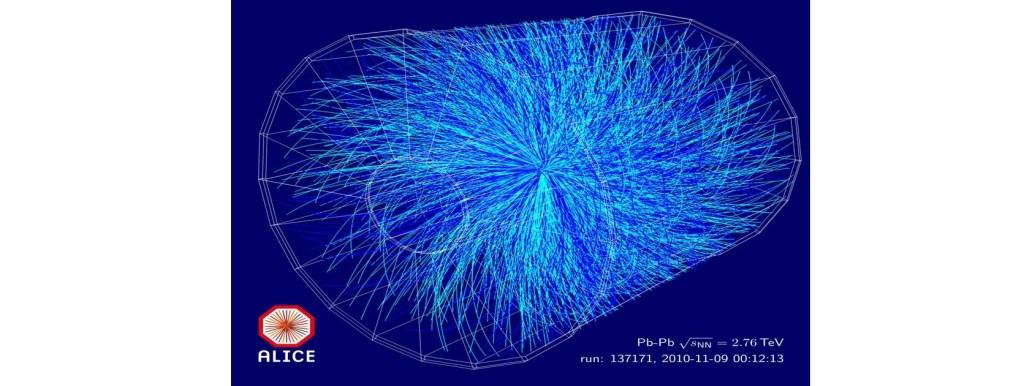
figure 1
Experiments have showed that Einstein’s famous formula E = m c2 is correct. Matter is concentrated “free” energy. Like E = h v in Planck’s formula for the energy transfer by electromagnetic waves (h = Planck constant).
If the electromagnetic field has no structure, the mass (m) in Einstein’s formula has to be replaced by n h (Planck constant multiplied by an integer) and divided by the size of the boundary of the energy concentration. In other words, Einstein’s formula E = m c2 shows that the volume of the universe must have a metric otherwise the formula is incomprehensible. And because there is an energy concentration, somewhere around the mass there must be an energy dilution too. Because all the energy in the universe is conserved.
In quantum field theory (QFT) the basic quantum fields are thought to be like phenomena. That actually means that a quantum field has “freedom” of motion under the right conditions. Like all the other phenomena. Theoretical physicists are also convinced that particles are local field excitations.
The problem with the concept of a local field excitation is that an excitation is dynamic, it is not static. That means that is there is a continuous force that creates and maintain the excitation. In other words, stop the force and the particle will vanish.
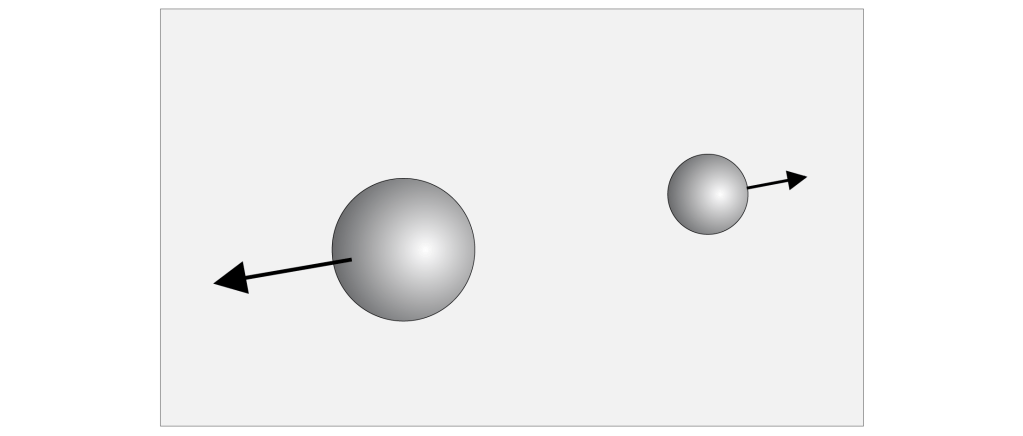
figure 2
But that is a difficult idea because in physics it is energy that creates a (local) change. That means that energy creates the energy excitation. But how is it possible that the universal electric field creates and maintain local energy excitations that we have termed ‘mass’? That is only possible if the universal electric field has some sort of structure and the local energy excitations are local concentration of energy within the universal electric field. That is the only solution to keep the energy of the universal electric field conserved.
I can draw in a schematic way a field structure in figure 2 – see figure 3 – but it accentuates the problem which field is represented. Because in QFT there are 3 basic quantum fields: the universal scalar field (Higgs field), the universal topological field (electric field) and the vector field that corresponds with the electric field, the magnetic field.
If each of these 3 basic quantum fields is a phenomenon (the QFT interpretation) each field has distinct properties. In other words, the schematic structure in figure 3 shows only one basic quantum field. I can add a second and third schematic structure – for example honeycombs and tetrahedrons – but there are only 3-dimensions. Thus how do these different basic quantum fields fit together in a 3D volume? Because one thing is for sure, the 3 basic quantum fields share the one and only volume of our universe.
Physics has revealed that the basic quantum fields can interact with each other. The easiest example is the interaction between the universal electric field and the magnetic field. Because the universal electric field and the magnetic field are corresponding fields. That means that a local energy increase of 1 h creates a corresponding increase of the magnitude of one or more vectors. Unfortunately the interaction between the Higgs field en the electric field, inclusive the corresponding magnetic field, is not easy to observe because the universal scalar field is totally flat in vacuum space. It means that every scalar in vacuum space has exactly the same magnitude (radius).
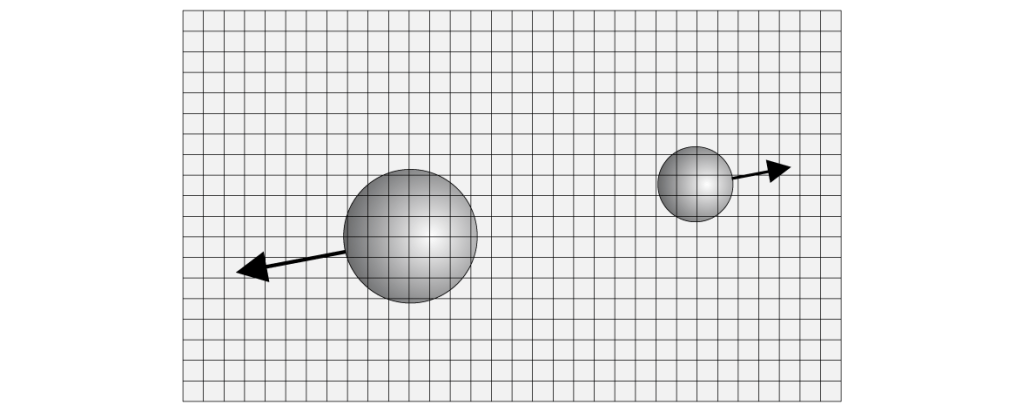
figure 3
The existence of the Higgs field was theorised in high energy particle physics by Peter Higgs. Because the magnitude of the scalars of the Higgs field doesn’t change at low energy interactions. The interaction is only “visible” at the energy density of sub-atomic particles.
Anyway, how is it possible that one basic quantum field can interact with another basic quantum field if both fields have only the all-inclusive volume of the universe in common (set theory). Because the universe is the set itself and the basic quantum fields are the elements of the set. Actually, the 3 basic quantum fields have different geometrical properties too. The scalars of the Higgs field are determined by their volume because the only true geometrical scalar is the sphere. The electric field is about topological deformation – “wave-like amplitudes” – and deformation is directly related to surface area. Vectors are 1-dimensional mathematical objects that don’t exist by themselves. That is why the universal electric field and the magnetic field are corresponding fields.
If the 3 basic quantum fields represent respectively 3D, 2D and 1D properties, it is not reasonable to speculate that the volume of the universe is filled with three distinct 3D fields. Because the existence of 3D, 2D and 1D properties prove that there exists only one field. Like the schematic image of a rest frame in figure 3.
Conclusion
The basic quantum fields in QFT cannot be phenomena. These basic fields are the manifestations of the structure of the volume of our universe. A structure that must be an all-inclusive rest frame. It is the rest frame that generates ‘phenomenological reality’ (reality like we know it).
