
The previous post (08) mentioned Einstein’s famous formula E = m c2. The formula expresses the equivalence of matter and energy. Before in 1900, it was Max Planck who discovered the quantisation of “free” energy (E = h v). Therefore, a particle like the proton represents a huge amount of energy in comparison with the energy of the Planck constant (h). The ratio between both energy quantities is about 1 : 2,277 x 1020.
If we look into the night sky we see an enormous empty darkness that is filled with light emitting celestial bodies (matter). Why there is so much emptiness in relation to the size of celestial bodies isn’t known. Because in phenomenological reality the volume of our universe shows to be homogeneous and isotropic for the “tangible” phenomena. Fortunately, if the universe has a structure – the quantisation of space itself – the enormous emptiness is easy to understand.
The surplus propagates within the structure a bit comparable with a row of toppling dominoes. It means that the units of the structure change their shape but don’t change their position. A row of toppling dominoes don’t return to the start position after the propagating “collapse” has passed. But the units of quantised space regain their average topological deformation after a high amount of topological deformation – for example a particle or a black hole – propagated within the structure.
If we suppose that a certain unit has an average deformation (at that moment it creates vacuum space with all the other units around), the ratio above shows that the unit can deform much, much more. A unit deforms 1 quantum at the time because the topological deformation of the all units in the universe is synchronized. If the propagation of the quantum is linear – from one side of a unit to the opposite side – the duration is a universal constant (1 tq) because the speed of light (c) is a universal constant. This constant of quantum time (1 tq) has a duration of ≈ 5,99 x 10⁻²³ second, because the metric (ℓc) of the structure is ≈ 0,5 x 10⁻¹⁵ m.
Planck’s “free” energy is the quantum of energy, a fixed amount of topological deformation (h). The quantum property itself is caused by the synchronisation of the continuous deformation of the shape of all the units. And the synchronisation is caused by the invariant and equal volume of every unit. Even the invariant volume has a underlying cause: the internal spherical shape forming mechanism of every unit and the tessellation of the volume of the universe by the units of quantised space. Of course, the latter is a strange formulation because the volume of the universe is created by the units of quantised space.
If we jump into matter, figure 1 shows what a local concentration of energy means for the surrounding units that represent vacuum space around an energy concentration. Because a unit that has a surplus of topological deformation of 1000 h needs 1000 tq to pass the deformation. This in contrast to a unit with a surplus deformation of just 1 h.
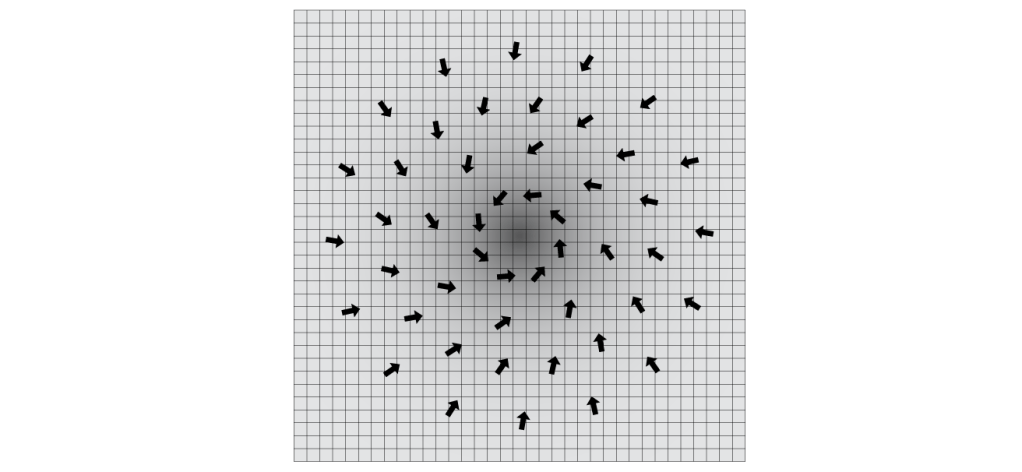
figure 1
The consequence is that concentrating energy means the creation of a “swirl” of energy around the concentration of energy. In macroscopic reality this is visible during the creation of a star from a cloud of dust and particles. Therefore at the microscopic scale size it is impossible to concentrate energy without the creation of angular momentum of the “free” energy in vacuum space around. At the microscopic scale size the “primordial” concentration of energy is already forced to spin and the surplus of energy of the units in vacuum space around are increasingly part of it.
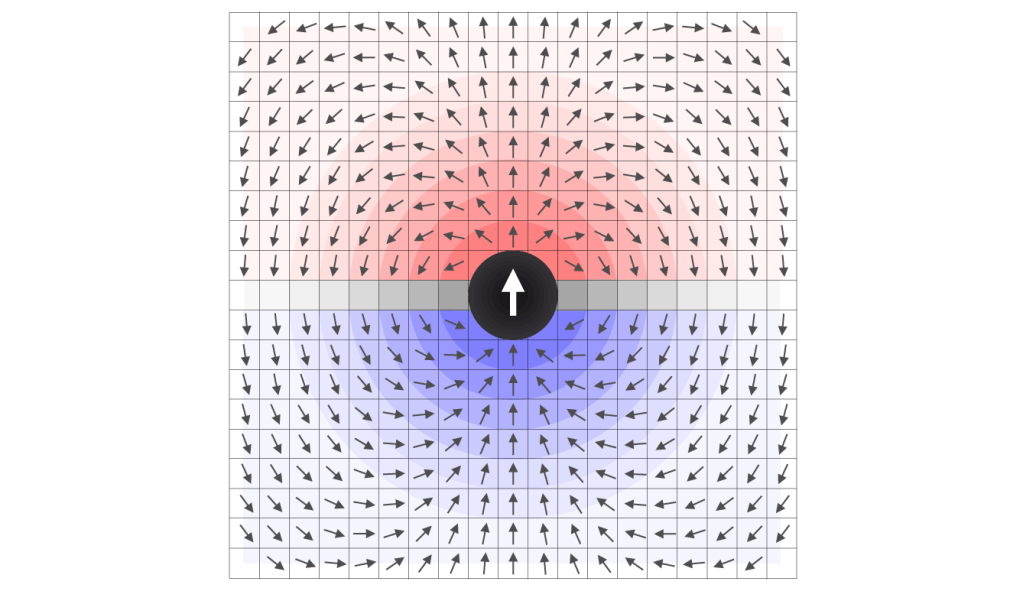
figure 2
Now the concentration of energy has created a particle (the black spot with the white arrow). The white arrow shows the direction of the motion of the concentration of energy (e.g. a neutron). In front of the particle the units in vacuum space are pressed to increase their topological deformation because of the nearing particle (red coloured units). Behind the particle the units release their forced deformation to return to the average energy density in vacuum space. The resultant arrows show the direction of the generated vectors of the magnetic field by the deformation of the involved units. In between both opposite parts there is a neutral zone. In other words, figure 2 shows a dipole that is generated by the propagation of the energy concentration within the structure of quantised space.
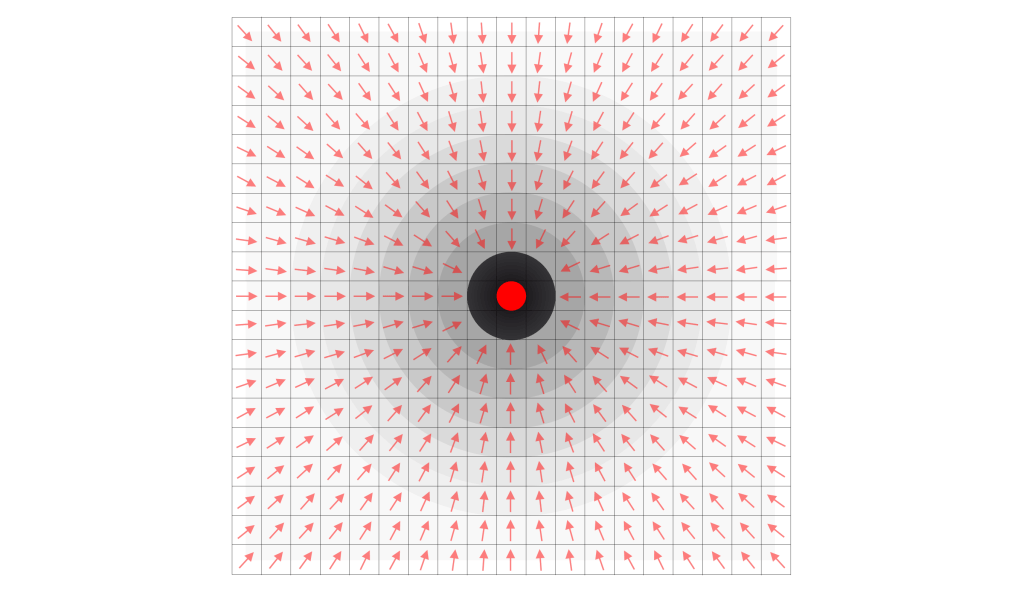
figure 3
Suppose the particle is not just an energy concentration like a neutron, all the units around the energy concentration have forced a scalar of the Higgs field in the centre of the energy concentration to decrease its radius. The consequence is that the points of contact between the decreased scalar and the 12 adjacent scalars are disrupted. Now each scalar of the 12 adjacent scalars has not 12 points of contact, but 11 points of contact. This asymmetry creates vectors in the scalars around the energy concentration (e.g. a proton). Figure 3 shows the particle (black), the decreased scalar inside (red) and the vectorisation of the flat Higgs field around the particle (red arrows). The “cubes” represent in a schematic way the structure of the units of quantised space. The concentric rasterised circles show the increase of topological deformation of the units nearby the particle.
The energy concentration – the particle – propagates in vacuum space and the decreased scalar is at the centre of the particle. The consequence is that the vectorisation of the flat Higgs field is co-moving with the particle. Thus an observer will describe the vectorisation around the particle as a local field that is part of the particle. But the particle is also a concentration of energy in motion, thus it has a dipole too (like figure 2). The result is figure 4.
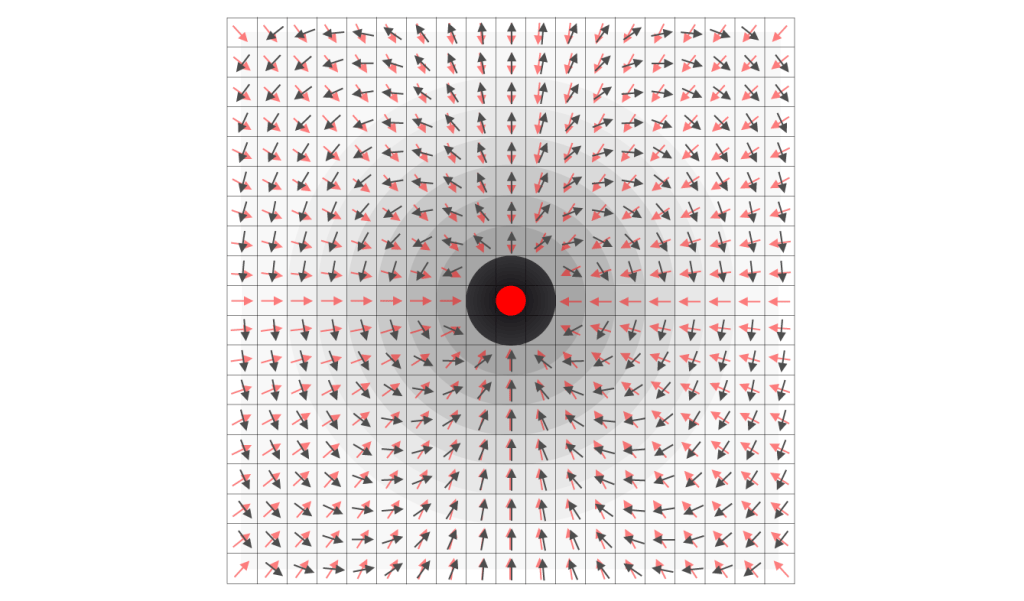
figure 4
The dipole is co-moving with the particle and the vectorisation of vacuum space around the particle is co-moving too. The total magnitude of the vectorisation is like a constant because the magnitude of all the involved vectors doesn’t change. That is why the forced decrease of the radius of a scalar is like a fixed threshold. That means that a fixed amount of topological deformation (energy) must be concentrated to start the decrease of the radius of the scalar.
Now the disk of the neutral zone (see figure 2) – perpendicular to the direction of the propagation of the particle in vacuum space – isn’t neutral any more. Because the vectors of the scalars in the neutral disk point towards the particle. The consequence is that in phenomenological reality the existence of the disk is not only observable at the atomic scale size (electron orbital), but also at the macroscopic scale size like planetary disks (e.g. Saturn), star systems and even spiral galaxies.
The co-moving influence of local concentrations of energy is easy to understand but it is not so easy to visualise because figure 4 doesn’t show the vectors of the “angular momentum” of the energy in vacuum space around the particle (neither the spin of the particle). That means that the symmetrical dipole in figure 2 (cross-section) is actually twisted. The amount of deformation of each unit during 1 tq is limited to 1 h. Thus no matter the high magnitude of all the involved vectors, the synchronisation of the topological deformation of all the units of quantised space act as a “change regulator”.
It is easy to understand that the human focus on the transformation of the geometry of energy represents only 50% of phenomenological reality. That means that there exists a nearly unexplored reality that is created by the influence of topological deformation on the scalars of the Higgs field in vacuum space. It influenced the choice for the title of the website: the non-observable universe.
