In String theory strings are supposed to exists at the Planck scale. It was thought that the 1-dimensional strings are the building blocks of the elementary particles. The first time I read about string theory was around 1983/1984. At that time the well known scientific magazines started to publish articles about the topic. The theory was hailed as the future of physics although the then theory suggested that our universe had 33-dimensions. That is not really convincing.
Unfortunately the whole idea of strings at the Planck scale is confusing because the Planck scale itself is highly speculative. Max Planck used the gravitational constant G in his formula to derive the minimal length scale of the universe. The whole idea behind the calculation of the minimal length scale is that the used constants are foundational. That means that there is a direct relation between the used constant and the basic properties of our universe at the smallest scale size. Albert Einstein (curved space) and Eric Verlinde (Newtonian gravity) showed that gravity is not an elementary force, it is an emergent force. In other words, the use of the gravitational constant in the equation to calculate the minimal length scale is not correct. So forget the Planck units.
Do strings exist as a fundamental phenomenon in nature? Because we humans cannot create in our mind what is not provided by the self generating fractal (the universe). If strings exist at a foundational level the question arises if these strings also existed in the primordial universe (the universe without matter). Because the present universe is dominated by a configuration that creates matter. The consequence of the latter is that strings can be a “spin off” that is directly related to the creation of matter by the basic quantum fields (structure of quantised space).
We cannot observe strings – there is no experimental evidence that strings exist – thus if they exist, it is reasonable to assume that strings “live” inside vector space (the flat Higgs field). In other words, we can hypothesize that matter influences the flat Higgs field in such a way that the influence create strings.
The influence of matter on vacuum space around is easy to understand because the creation of matter changes the amplitudes of the electromagnetic field in vacuum space. Figure 1 shows a proton with a decreased scalar inside (red dot). The decreased scalar disrupts the point of contact with its 12 adjacent scalars and the result is the vectorisation of vacuum space around the decreased scalar (red arrows). These vectors are not created by the topological deformation of the deformed parts of the units of quantised space. The vectors are the result of the unbalance of the scalars of the flat Higgs field around the decreased scalar.
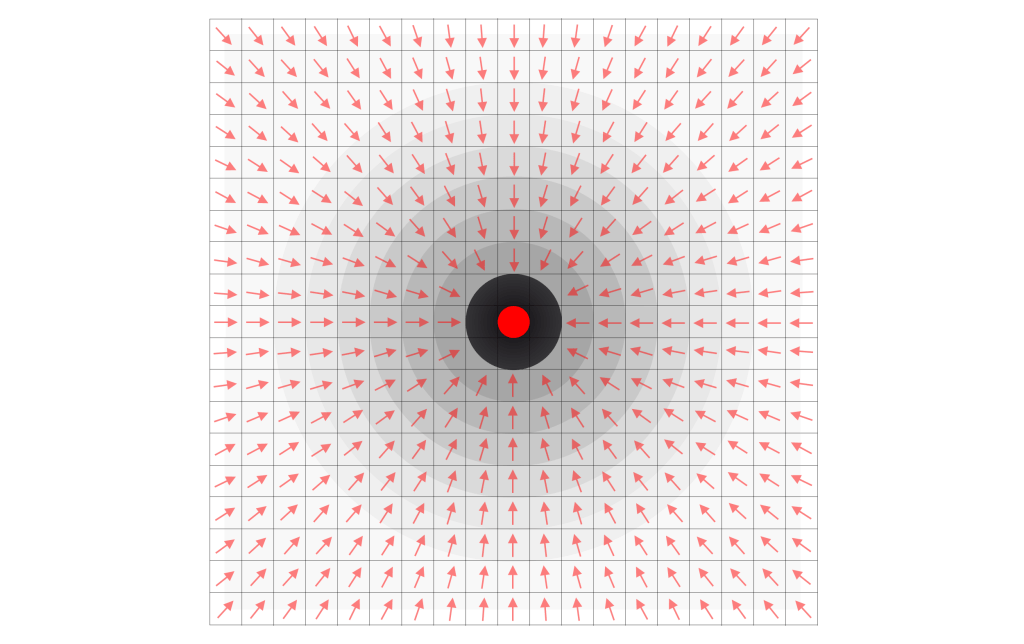
figure 1
The magnitudes of the vectorisation nearby the decreased scalar is about 1018 in comparison to the magnitude of a vector of the magnetic field that represents 1 h (the Planck constant). The decrease of the magnitude of the vectors that are created by the decreased scalar is directly related with the amount of scalars that share the same distance from the decreased scalar. In other words, at a certain distance from the decreased scalar the magnitudes of the generated vectors near the magnitudes of the vectors of the magnetic field. Although the motion of the particle also generates a distinct dipole configuration in vacuum space around the particle that overrules the average magnitudes of the vectors of the magnetic field (figure 2).
By the way, the orientation of the generated dipole is perpendicular to the motion of the particle. Because the particle forces the units around its trajectory to adjust their topological deformation. Figure 2 don’t show the helical motion of the particle and the dipole in relation to the rest frame (structure of quantised space).
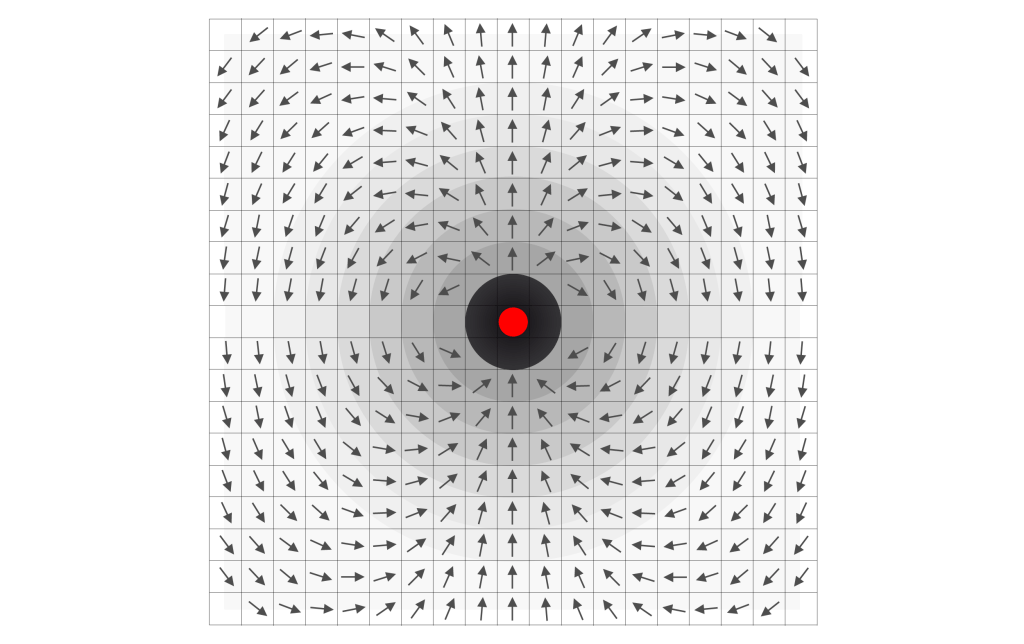
figure 2
Both figures show vectors that have higher magnitudes than the vectors of the magnetic field. But only a row of vectors in figure 1 can be interpreted as a string. The vectors in figure 2 show some resemblance with water that is displaced by the hull of a ship in motion.
Strings are supposed to have a limited length (size) thus it is not reasonable to assume that the vectors in figure 1 (red arrows) are strings. Not at least because all these vectors are co-moving with the particle. I suppose that the hypothetical string must be detached from the particle. The only “mechanism” to cut off vectors is the shielding of vectors by decreased scalars. Figure 3 shows an example. The image shows 2 particles – like the one in figure 1 – and both particles are nearing each other because of the mutual interruption of vectors (the 2 black arrows).
Now think about it. The vectorisation of vacuum space around a particle represents the unbalance of all the involved scalars because of the interruption of the 12 points of contact of the decreased scalar with the 12 adjacent scalars. Figure 3 is like a screen shot (static image with only a little amount of information). But the 2 particles have their individual direction and velocity of motion. Figure 3 only shows why a part of the motion of the 2 particles represents a push towards each other (the 2 red arrows).
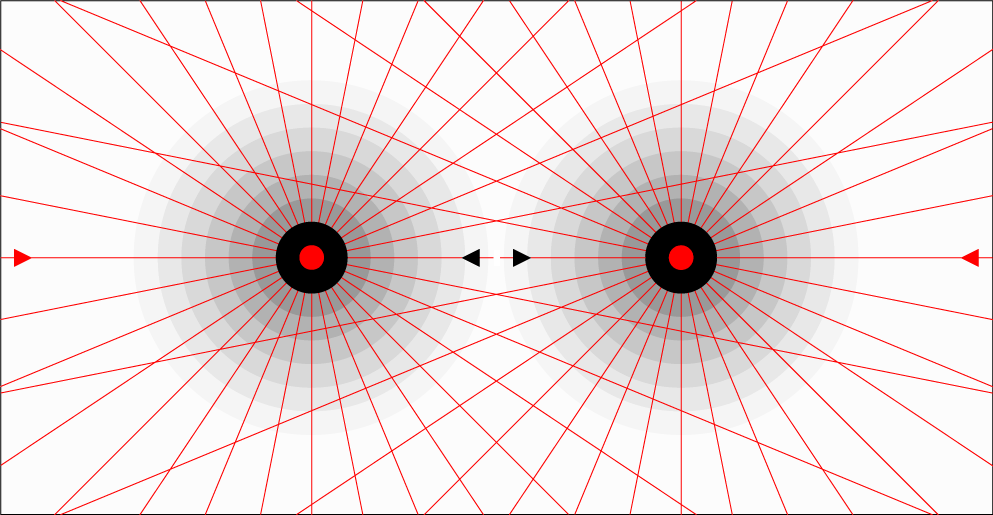
figure 3
If we pick up one of the schematic resultant vectors (red lines) we can describe the magnitude of the vector as a range of decreasing numbers and the highest number (magnitude) is the adjacent scalar of the decreased scalar in the centre of the particle. Suppose the range is: 1000 – 999 – 998 – 997 – 996 – 995 – 994 – 993 – 992 – 991 – 990 – 989 – 988 – 987 – etc.
If a vector is cut off by the decreased scalar of the other particle – e.g. it is cut off at 989 – the whole range from 988 to zero has lost the attachment with the decreased scalar. That means that the causation of the unbalance of these 988 scalars is detached. These scalars are part of the rest frame of the universe – the structure of quantised space – thus the next moment the particles move on and the string of unbalanced scalars – 988 to zero – is left behind in relation to the moving particles. Thus from now on the string exists “on its own”.
The consequence is that the string of vectors starts to rearrange the sequence of their magnitudes. Thus instead of a range of decreasing vector magnitudes the involved scalars start to redistribute the unbalance. Suppose the numbers of the range not only describe the distance of a distinct scalar from the decreased scalar of the particle, but it also represents the magnitude of each scalar. The consequence is that the redistribution will result in vector magnitudes around 499. Not exactly 499 because scalars are involved in the never ending transformation of the shapes of the units of quantised space.
Anyway, the roughly described mechanism that results in the creation of “independent” vector strings everywhere in the universe can be seen as a promising hypothesis to explore further. Especially because a huge amount of descriptions of human experiences – like NDE, out of body experiences, remote viewing, the afterlife, etc. – suggest the existence of “independent” vector phenomena.
↑ contents of The Non-Observable Universe
