
At the end of the post ‘Spherical mechanism’ there is an example how to interpret the geometrical properties of the units of quantised space. The “trick” is to compress identical deformable spheres into a large volume in such a way that there is no volume left in between the deformable spheres.
Figure 1 shows the lattice of the flat Higgs field so it is clear that the distribution of the 12 points of contact on the surface of the scalar of a unit isn’t 100% symmetric. Because the layers 1 and 2 have a rectangle arrangement and the layers a, b and c a triangle arrangement. In other words, every scalar is part of triangle layers and rectangle layers.
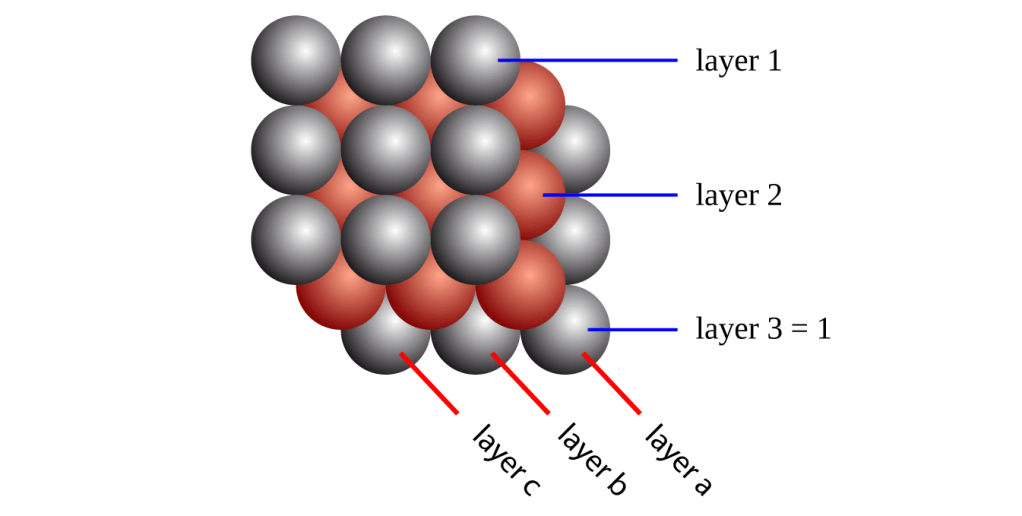
figure 1
If the volume is totally filled with spheres we start to add more spheres into the volume and this is possible because the spheres can deform. Figure 2 shows 3 spheres in a triangle arrangement. If we push the spheres towards each other to wipe out the empty volumes in between the spheres, we have to deform the grey concentric shells in order to facilitate that the not deformed parts will touch each other (creating 3 points of contact).
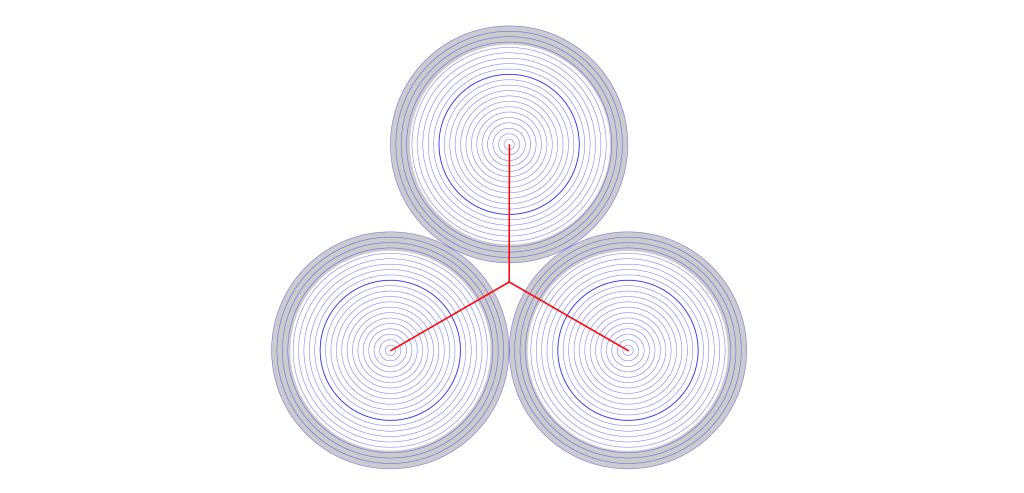
figure 2
If 4 spheres have a rectangle arrangement the situation is different. Because the volume in between the 4 spheres is much larger than the volume in between the 3 spheres (figure2). Figure 3 shows how much deformation is needed to facilitate the 4 spheres to create 4 points of contact with no empty volume in between the 4 spheres.
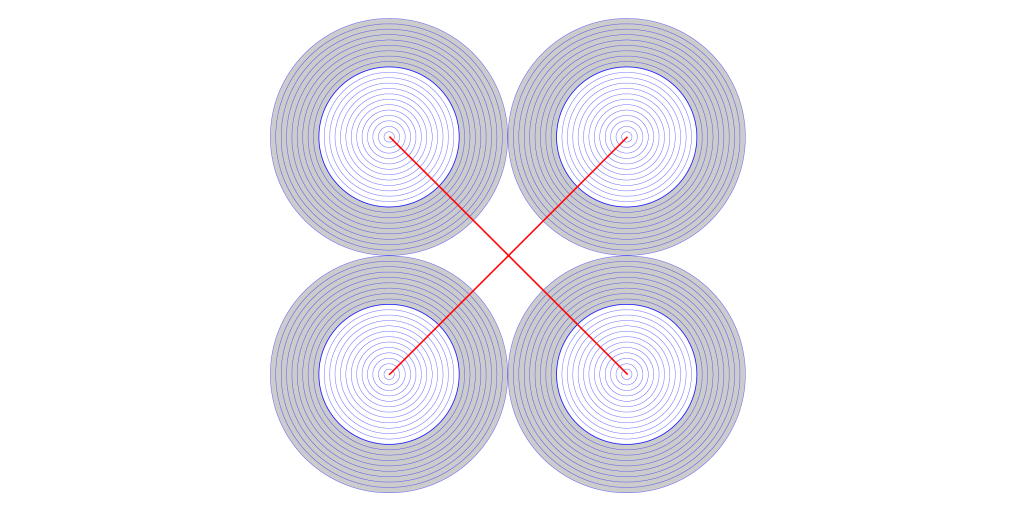
figure 3
However, figure 3 isn’t realistic because long before all the empty volume in between the 4 spheres is pushed away the triangle configuration was forced to push deformed volume of their concentric shells towards the large volume in between the arrangement of 4 spheres (figure 3). It is easy to understand because if the radius of a scalar of a unit of quantised space is r = 1,0 the radius of an imaginary solitary unit is r = 1,105 (see figure 4). That is in line with the ratio between the volume of a scalar in vacuum space and the volume of the deformed part of a unit (76% and 26%).
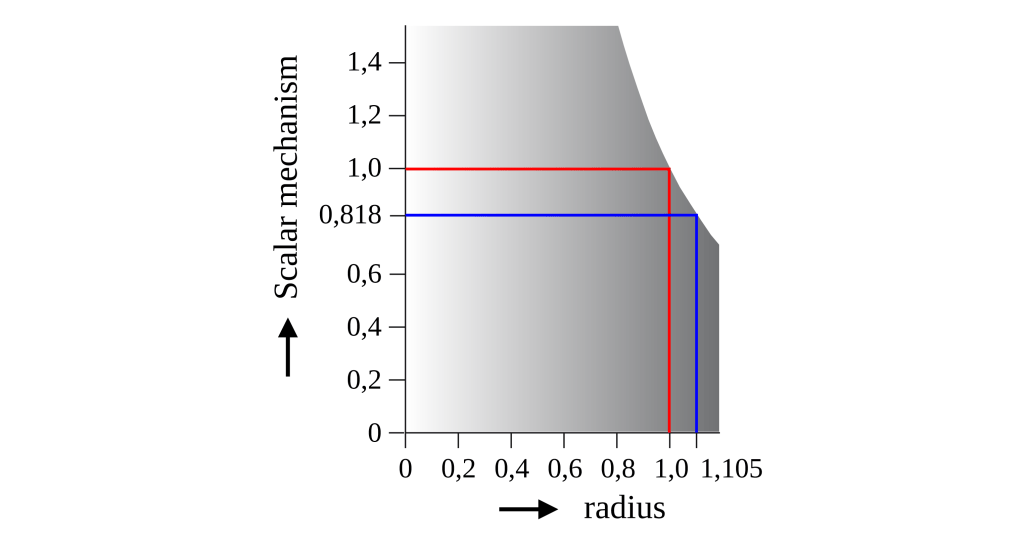
figure 4
Figure 2 and 3 show the forced deformation of the spherical shape forming mechanism of every unit of quantised space because of the existence of a scalar lattice with the highest density of scalars (figure 1). Figure 5 shows an imaginary solitary unit – a sphere – and I have drawn the triangle and rectangle points of contact (crossing circles) on its surface. The red arrows show the direction of the push of deformed volume towards the rectangle areas if the shape of the solitary unit is slowly deformed.
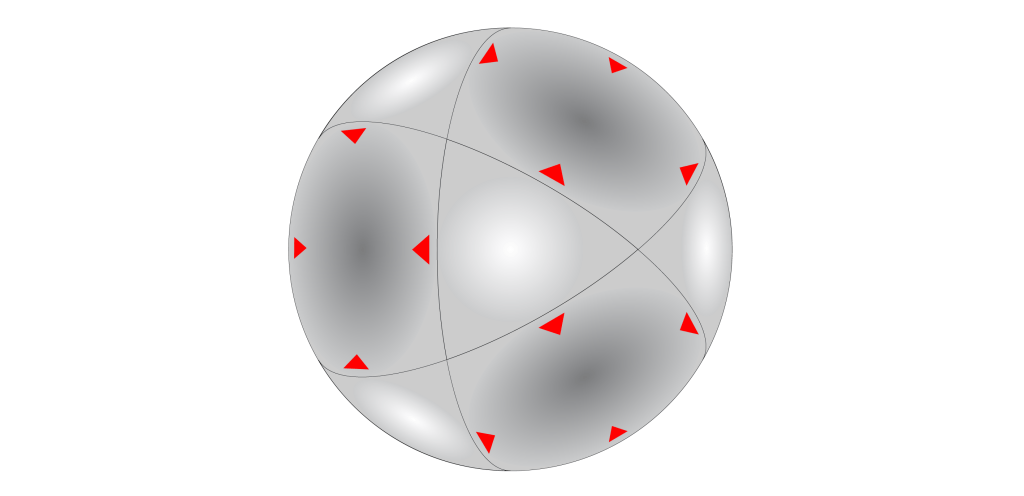
figure 5
Suppose the universe is static and every unit of quantised space has the same shape. The result is figure 6, a scalar inside a rhombic dodecahedron. I have drawn the vectors (black arrows) inside the scalar that are pointing towards the points of contact with the 12 adjacent scalars (see figure 1). The red outline is the shape of the rhombic dodecahedron. The image suggests that the surface area of a unit is equal to the surface area of the rhombic dodecahedron. But figure 5 shows that the internal spherical shape forming mechanism is not only deformed, parts of the deformed volume with a different resistance against deformation were forced to fill up the missing volume in between the rectangle arrangements.
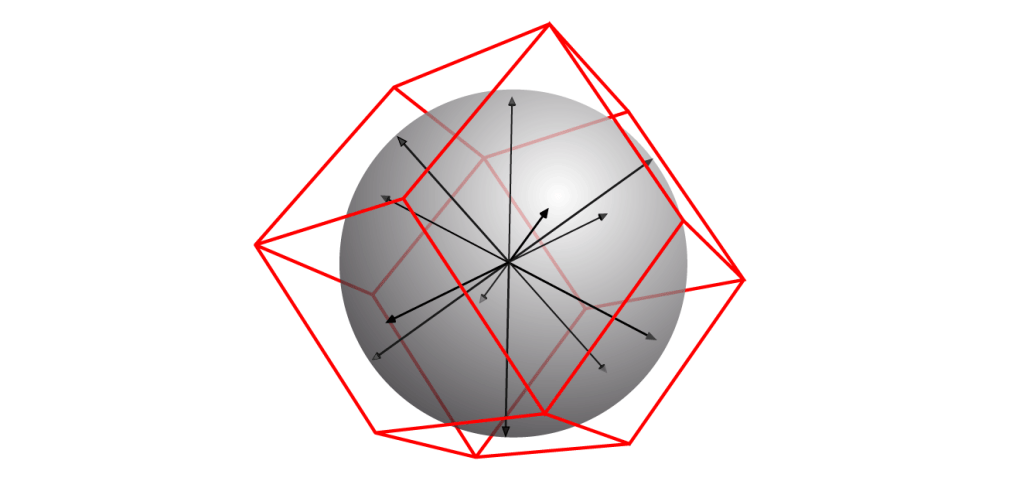
figure 6
Because figure 2 shows the forced asymmetry of the internal spherical shape forming mechanism (short: “scalar mechanism”). That is why it is impossible that the surface area of a unit of quantised space is equal to the surface area of the rhombic dodecahedron.
The consequence is that the average boundary of a unit of quantised space has a larger surface area than the minimal area for the given volume. In other words, the scalar mechanism of every unit tries to restore the lost shape of a sphere at the cost of the units around (a push force). Regaining the shape of a sphere is impossible but the result is that units have different surface areas because units have different shapes. This surplus of surface area can be concentrated and the process manifests itself in Einstein’s famous formula
E = m c2. It is in line with the definition that the total amount of surplus surface area is conserved (law of conservation of energy).
