
In physics the magnetic field is a vector field. The vectors are generated by the universal electric field and that is why the universal electric field and the magnetic field are known as corresponding fields. In the previous post (009) figure 3 shows a particle with a decreased scalar of the Higgs field inside. The result is the vectorisation of the flat Higgs field around the particle (red arrows).
Now there is a problem because if the universal electric field and the magnetic field (vector field) are corresponding fields what is the origin of the vectors in post 009, figure 3? Because all the vectors in the universe are conserved. It is the consequence of the law of conservation of momentum. Every quantum of energy has momentum, thus momentum isn’t about one fundamental property, it is about 2 properties: energy and the direction of the energy (vector). All the energy in the universe is conserved, thus all the vectors in the universe are conserved too.
If the flat Higgs field around a particle with a decreased scalar is vectorised, these vectors are also part of the total amount of vectors in the universe. In other words, before the particle was created the vectors of the vectorisation by the decreased scalar were vectors of the magnetic field.
Figure 1 shows some sort of diagram to clarify what is going on in the universe in relation to the topological transformations of the universal electric field – the deformed part of every unit of quantised space – and the corresponding vectors that are generated by these transformations.
We can imagine a universe without matter (A). That means every scalar in the scalar lattice of the Higgs field has exactly the same magnitude (radius). Thus the whole universe is vacuum space and all the transformations are limited to the change of the amplitudes of the surplus of energy and the corresponding vectors of the magnetic field. The colour of the universal electric field (red) and the colour of the magnetic field (green) represent the average energy density and corresponding average vector magnitudes.
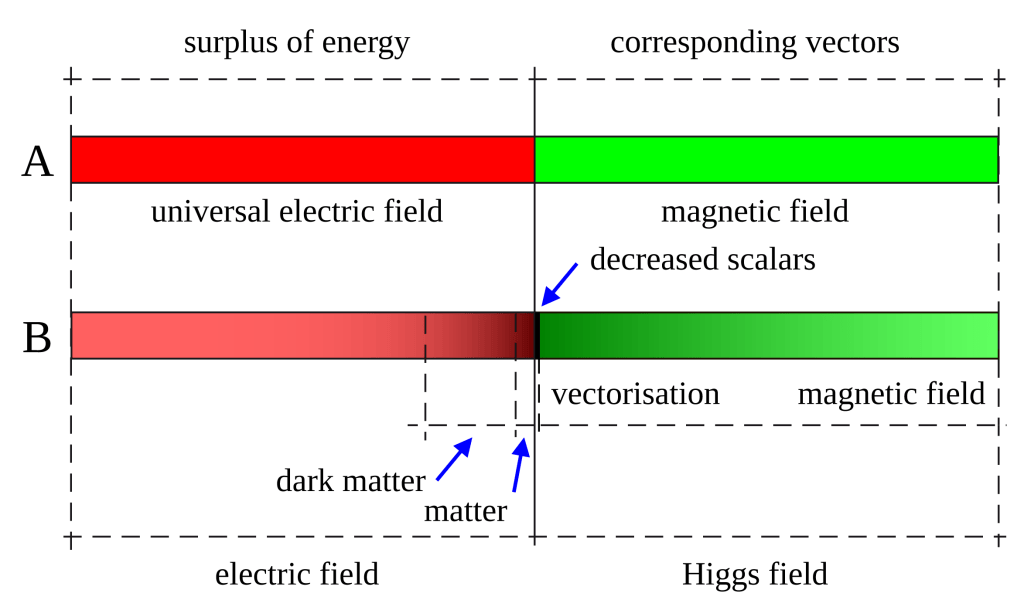
figure 1
However, our present universe has matter (B). Matter is highly concentrated energy (E = m c2), thus the average energy density of the universal electric field in vacuum space has decreased. But a part of the energy in vacuum space has a higher energy density because it is continuously pushed by the spherical mechanism of every unit of quantised space towards the existing large scale configurations of matter (dark matter around galaxies).
If the average energy density in vacuum space decreases, the spherical mechanism of the involved units creates less energetic electromagnetic waves. The consequence is that electromagnetic waves are forced to increase their wave length all along their trajectory in vacuum space. This effect is termed the non-Doppler red shift of the light of distant galaxies. In other words, the further away the galaxy, the more red shift the emitted electromagnetic waves have accumulated.
There is a big difference between energy and vectors. Because the propagation of energy is limited by the speed of light (c), but vectors act instantaneous. It means that the influence of energy over a distance has a duration and the influence of vectors has no delay. The consequence of the absence of delay is that the balance between opposite vectors is constantly up to date. Vectors can be super positioned and that is why the vectors of the magnetic field and the vectors generated by decreased scalars (matter) can be interpreted as “mixed” in vacuum space.
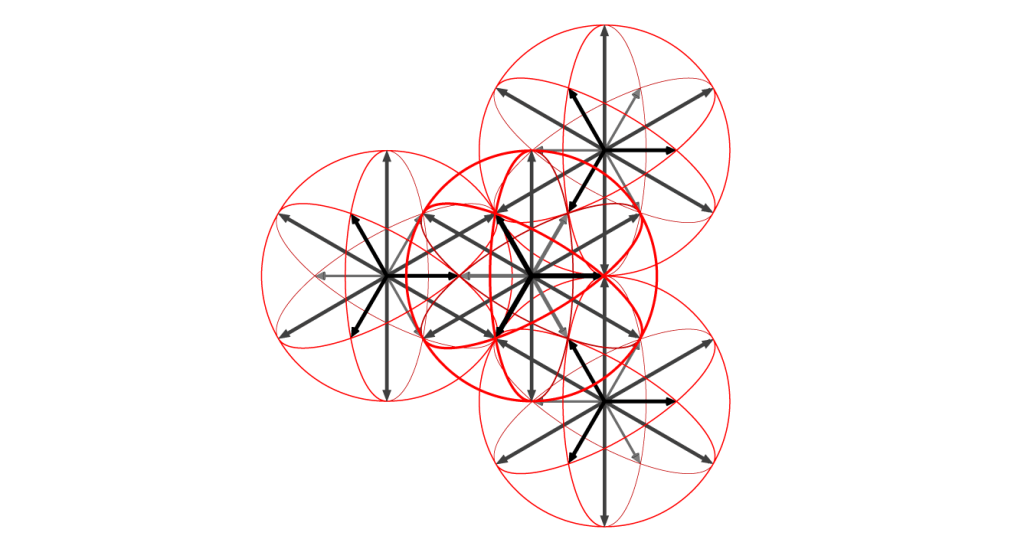
figure 2
Vectors are only mediated by the points of contact between the scalars that are part of the flat Higgs field (every scalar has exactly the same radius). Thus vectors cannot be mediated by decreased scalars. For example, inside a black hole there are only decreased scalars, thus vectors cannot be mediated by the scalars.
Every scalar has vectors that are created by the points of contact with the adjacent vectors (figure 2). What we have termed “magnetic field” are the vectors that are super positioned on the vectors of the scalars. Because the vectors of the magnetic field are generated by the transformation of the shapes of the units of quantised space. Figure 3 shows the deformation of the joint area between 2 units of quantised space. The inlays A an B show the deformed surface area. It is easy to understand that the unit at the right increases the force on the scalar of the unit at the left side. Thus the topological deformation of the units is transformed into super positioned vectors because only the points of contact can mediate these continuous changing influences. That is why “vector space” is actually the flat Higgs field.
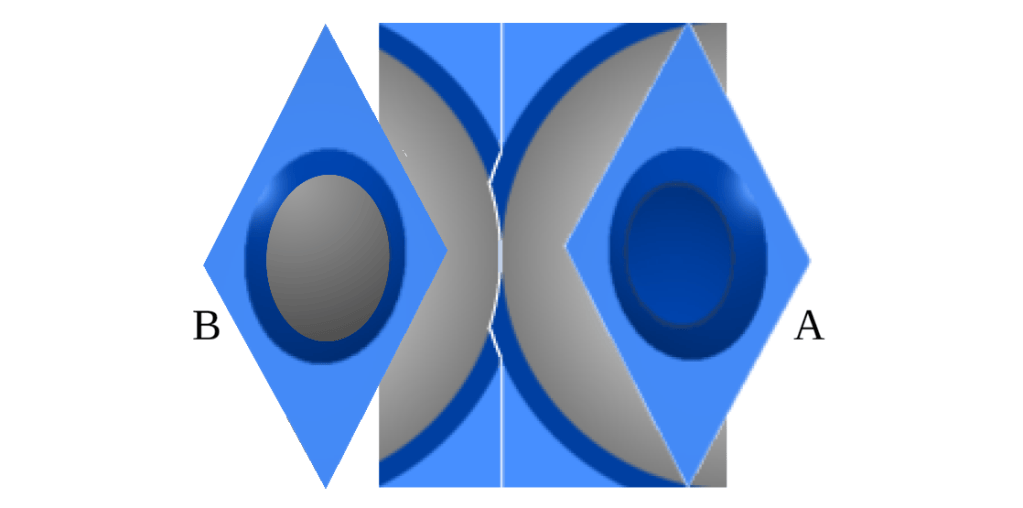
figure 3
The topological deformation of the joint area between 2 units in figure 3 is part of the continuous topological deformation of a unit with all the adjacent units around. Every unit has an equal and invariant volume thus the input deformation is equal to the output deformation. The deformation is only possible if a unit transfers an amount of its volume within its boundary – see post 003, figure 3 – thus I can write: Vinput = Voutput. That means that Planck’s constant represents ½ h input and ½ h output.
Figure 4 shows a unit and the not deformed shape of the unit is drawn as a rhombic dodecahedron. The bi-directional arrows represent the deformation of the joint areas of the unit with the 12 adjacent units. The consequence is that Planck’s ½ h input and ½ h output are distributed over 2 or more joint faces. Thus we cannot assume that the deformation of a joint face increases/decreases with ½ h because the deformation of a joint face is not quantised. Only the total deformation of the unit during 1 tq (constant of quantum time) is quantised. No matter the magnitudes of the vectors from everywhere around that are mediated by the points of contact with the scalars of the adjacent units.
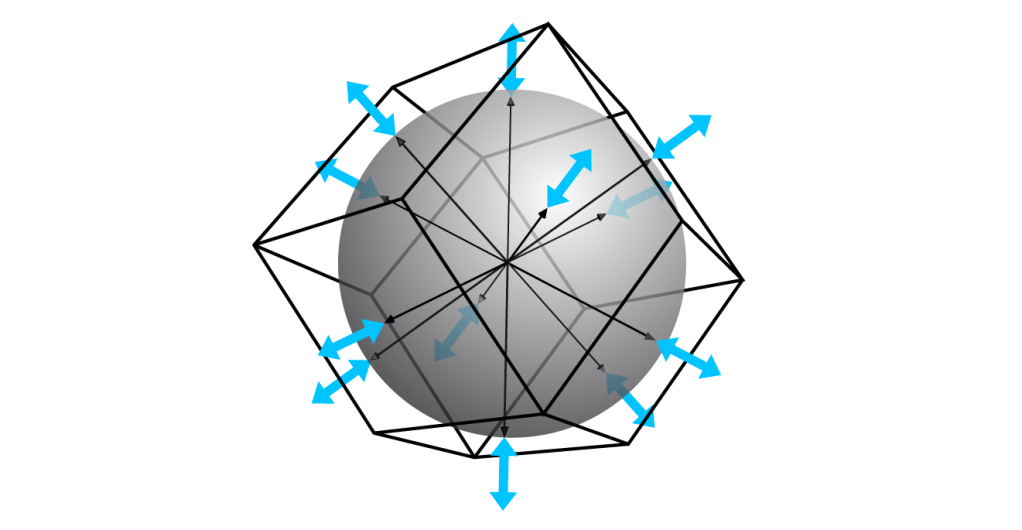
figure 4
Figure 5 shows the vectorisation of vacuum space around a particle with a decreased scalar inside. These vectors are not part of the magnetic field. That means, generated by the local amplitudes of the universal electric field. That is why the question arises how the “phenomenon” of this type of vectors is termed in theoretical physics. It is a bit disappointing, but I don’t know the right answer. This type of vectors exist inside an atom because the atomic nucleus has one or more protons inside. But the vectors don’t stop at the outer electron orbital of an atom. That means that the vectors influence other atoms too. Not by “attracting” other atoms because attracting forces don’t exist in vacuum space.
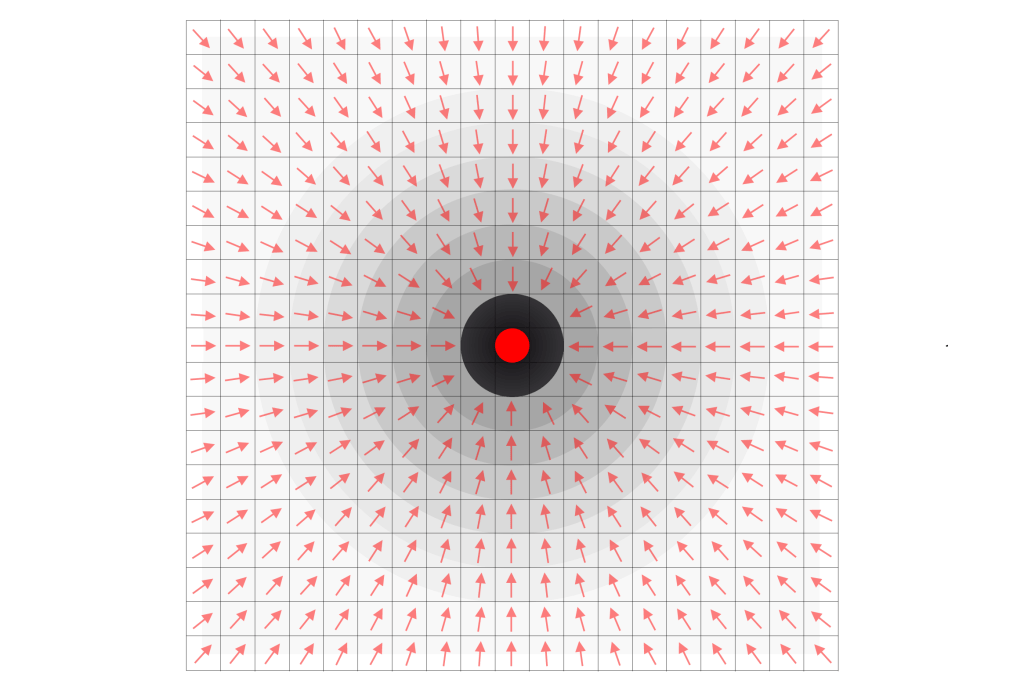
figure 5
I have expanded figure 5 with a second particle (figure 6). To keep it simple I have drawn simple resultant vectors (red) and not drawn the schematic units of quantised space. The vectorisation of vacuum space is attached to the particles, like the increased deformation of the electric field around the particles (grey rasterized concentric “shells”). The consequence is that the 2 particles in figure 6 are pushed towards each other because they shield each other vectors. But at a short distance the particles will experience an increasing amount of resistance because of the local increasing density of the electric field (grey rasterized concentric shells).
The shielding creates a resultant force that is directly related to the mutual distance between both particles (or atoms, matter objects, celestial bodies, etc.). However, the spherical mechanism of each unit of quantised space generates a push force too. That is the mechanism that creates local concentrations of energy that result into a decreased scalar. The consequence is that there exists no “clean” push force. There is always a mutual interference between the universal electric field and the generated vectors in “vacuum space”.
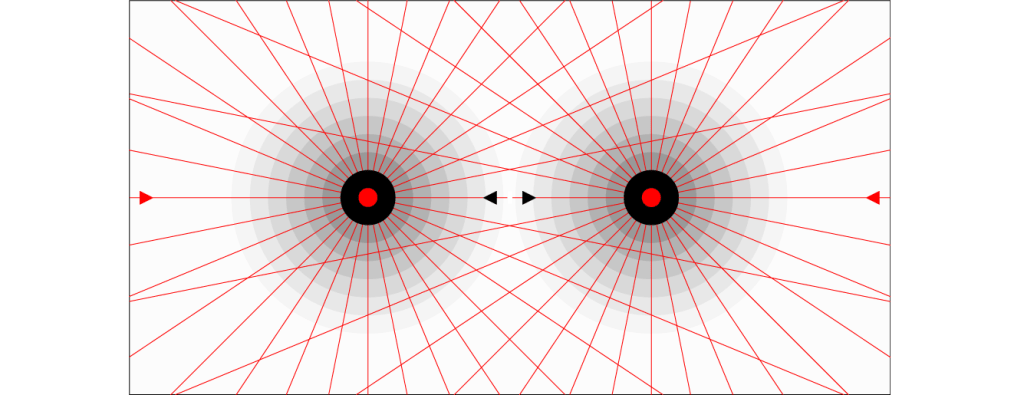
figure 6
We are used to imagine and think about the behaviour of “tangible”phenomena, like reality in daily life. But we don’t have a sense organ that detects what is going on in “vector space”. At least not in a way we can easy understand, if our perspective is phenomenological reality. Thus the aim to explore the non-observable part of the universe is not a simple plan.
In most cultures there are descriptions about the existence of a non-material reality. Wikipedia has pages that describe human experiences that are beyond phenomenological reality. Like out-of-the-body experience (OBE), the mind-body dualism, near-dead experiences (NDE) and of course descriptions about the existence of a soul, a heaven and a hell.
Unfortunately, the physics text books don’t describe the existence of a non-material reality. But if the theoretical framework that is described in the text books is correct these human experiences must originate from the same source as the basic quantum fields, particles, atoms, celestial bodies, etc. Moreover, understanding non-observable reality will give us a better insight in phenomenological reality.
In the posts to come the focus is on the exploration of the non-observable part of reality. Not with the help of another reference frame, I will use the same “underlying” model, the structure of quantised space.
