
If the units of quantised space are continuously – in a synchronised way – changing their shape with all the other units that tessellate the universe, how will these changes show up? It is clear that the deformations occur under invariant volume and that the “power” to change the shape of a unit is the internal spherical shape forming mechanism. The size of the boundary of the unit isn’t the minimal surface area in relation to its volume – see ‘Topological deformation’ – thus there exists a surplus of surface area in the universe. That is what we have termed ‘energy’.
Figure 1 shows 3 different points of view to interpret a unit of quantised space. Image I shows the unit as a deformed sphere. The scalar (S) inside is 74% of the volume of the whole unit. The deformed part is known in physics as the universal electric field (E).
The focus in image II is on de scalar. Its size is determined by the points of contact with the adjacent scalars because every scalar has exactly the same radius if the local Higgs field is flat. Because these points of contact are really small the internal spherical shape forming mechanism (short: scalar mechanism) creates a mutual influence with each adjacent scalar that shows itself as a 1-dimensional vector (black arrow).
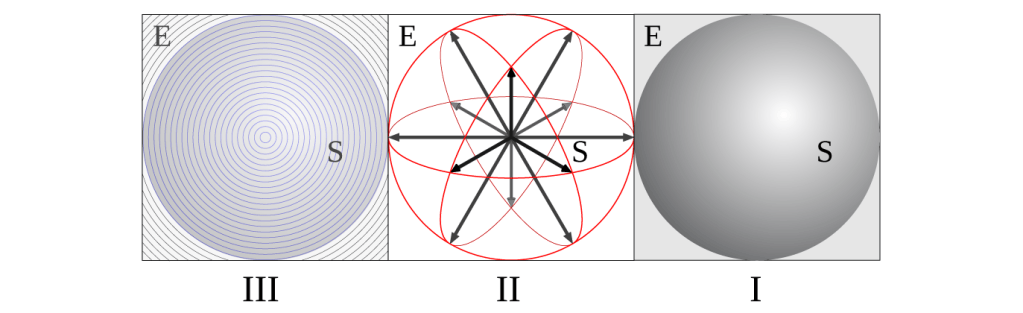
figure 1
The aim of image III is to visualise the spherical shape forming mechanism with the help of small concentric shells. The visualisation isn’t 100% correct because in the previous post it is explained that – because of the deformation of the unit – the scalar mechanism of the electric field is not only deformed, but also drastic displaced within the boundary of the unit. Nevertheless, image III shows that the effort of the scalar mechanism to expand its undistorted volume (the scalar) will be at the points of contact with the 12 adjacent scalars. Figure 2 shows the cross section of 2 adjacent units with a deformed joint area.
The only way to transform the shape of a unit under invariant volume is to transfer infinite small “grains” of volume inside the unit. Unfortunately, figure 3 in ‘A mathematical construct’ shows that topological deformation under invariant volume forces volume to become surface area and visa versa. However, figure 3 in that post shows the principle, not the actual situation in quantised space.
The cross section of the topological deformation in figure 2 shows the 2 scalars (grey) and the deformed volumes of both units (blue). To create the drawn deformation both units had to transfer infinite “grains” of volume inside and the dark blue coloured part of the deformed volume of each unit is the part that was involved in the transfer (see image III of figure 1).
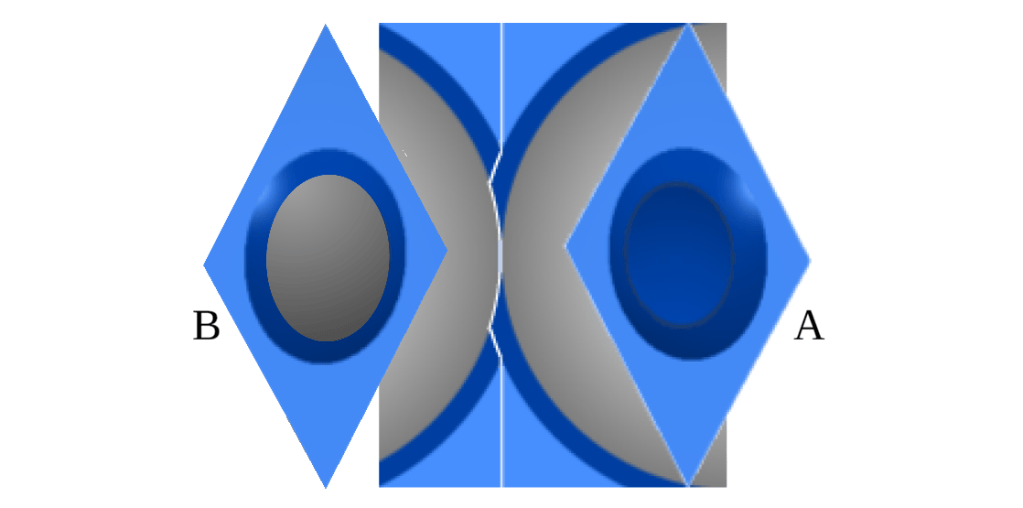
figure 2
The rhombic inlay B in figure 2 shows the area, seen from the unit at the right side. The boundary of the unit at the left isn’t only the surface area of the deformed part of the unit, because a part of the area is the “naked” part of the scalar of the unit at the left side, if the area is seen from the right side. If we think about it we have to conclude that the total joint surface area of the deformed parts of both units must be invariant too. Thus all the energy fluctuations in vacuum space are like an exchange of surface area between the “naked” parts of the scalar of a unit. Because the surplus of surface area of the unit – energy – will manifests itself as the deformation of the rhombi in figure 2.
If a scalar decreases its radius, the situation totally changes. Because a decreased scalar has no points of contact with the scalars of the adjacent units. The consequence is that the deformation of the unit with decreased scalar isn’t restricted to the areas around the points of contact. And each of the adjacent units has an interrupted point of contact too. More worse, the decrease of the scalar is forced by a large number of units that have concentrated a part of their surplus of surface area. This concentration of topological deformation is like a push force from around. In other words, the properties of a unit with a decreased scalar are determined by the units of the large volume around the unit with decreased scalar. The latter is a simplification of what is going on because the rest frame – the structure of the units of quantised space – doesn’t move at all. It is the mutual influence between the units of quantised space that manifests itself as phenomenological reality. And every linear propagating quantum of energy (h) has the speed of light (c) because all the units of quantised space have identical basic properties.
The importance of the invariance of the surface area of the deformed part of a unit that represents vacuum space during a certain moment is that it solves the problem around the transformation of volume into surface area and visa versa. Because the surface area is a joint area between 2 units. If we focus on this joint face it is difficult to understand topological deformation if the surface area isn’t invariant. Because the units of quantised space have an invariant volume and are indivisible. Thus if a part of the volume of a unit becomes joint surface area, what will prevent the adjacent unit to use a part of the surface to “fill up” its volume? In other words, it is hard to imagine that surface area and volume are interchangeable.
